Hoka vs Salomon: Which Shoe Brand Is Better for Hiking?
Hoka vs Salomon compared for hiking and trail running: cushioning, grip, fit, waterproofing and model match-ups. Find the right brand for your feet.

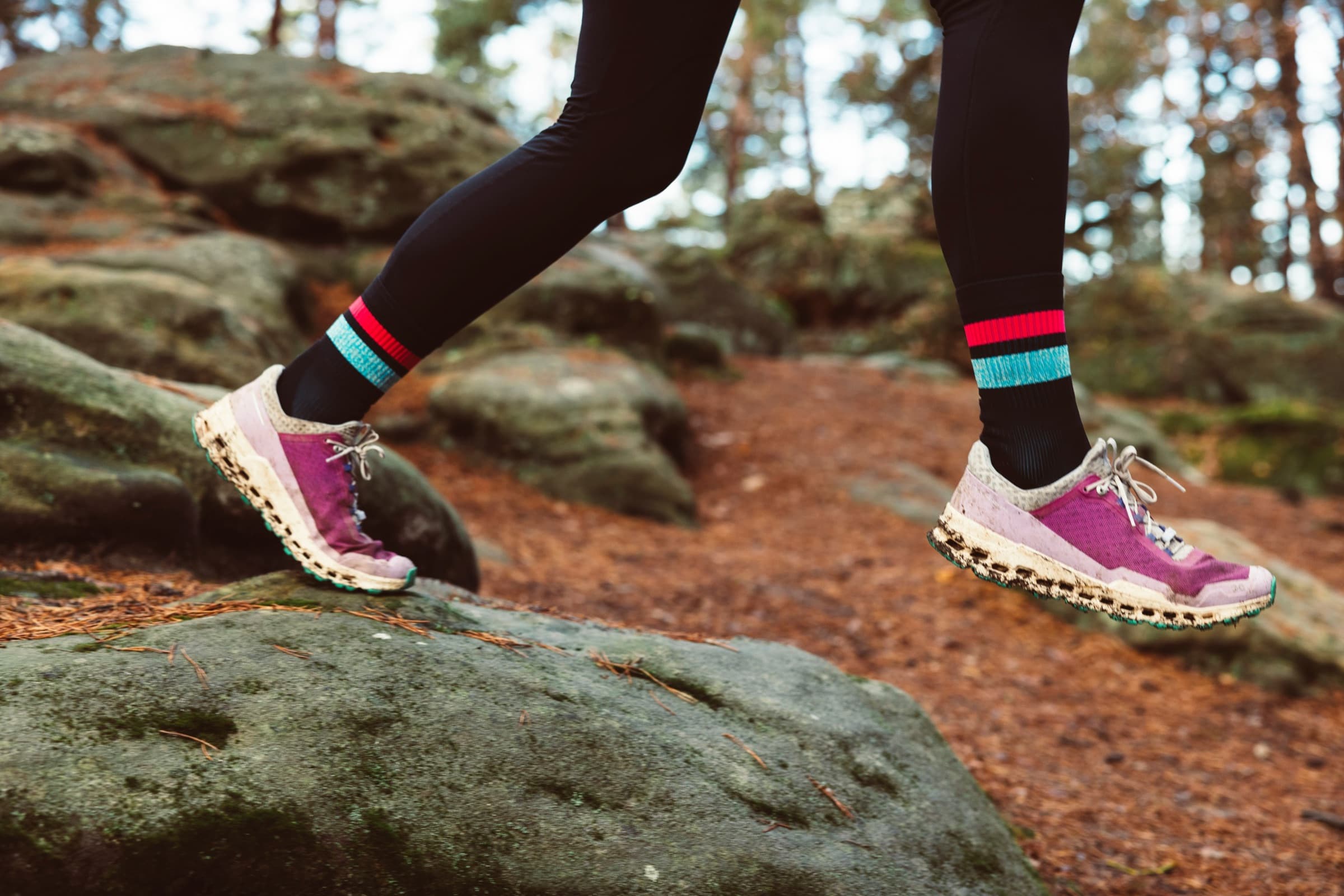
Hoka vs Salomon comes down to how you want the trail to feel. Hoka builds tall, soft, rockered shoes that soak up impact and keep your legs fresher on long days, while Salomon builds lower, firmer, more precise shoes with aggressive grip that keep you planted on mud, rock and steep ground. Pick Hoka if comfort over distance is your priority, and Salomon if traction and stability on technical terrain matter more.
That's the short version. The longer one depends on your terrain, the shape of your feet and whether you need a boot or a trail runner. This guide compares both brands category by category, then puts their most popular models head to head. If you're still working out which Salomon line suits you, our guide to the best Salomon hiking shoes goes deeper into the X Ultra and Quest families.
Brand Overview
Here's a fun detail most comparisons skip: both brands come from the same town. Hoka was founded in 2009 in Annecy, France, by Nicolas Mermoud and Jean-Luc Diard, two former Salomon employees. Salomon has been based in the Annecy area since 1947. Same Alps, very different ideas about what a mountain shoe should be.
Hoka: Maximum Cushion, Rolling Ride
Hoka started with one radical idea: give runners far more foam than anyone thought sensible, then shape it so it still moves efficiently. Its trademark Meta-Rocker is a curved sole that rolls your foot from heel strike to toe-off, so you spend less effort pushing through each step. The brand has been owned by Deckers since 2013 and has grown from a niche ultra-running label into one of the biggest running brands in the world.
On the trail, that translates into stack heights (the amount of foam between your foot and the ground) of 35 to 40 mm or more on many models. Most of Hoka's trail and hiking range uses Vibram Megagrip rubber, which is one of the stickiest compounds on wet rock.
Salomon: Precision, Grip and Ground Feel
Salomon, now part of Amer Sports, grew out of skiing and still designs footwear like ski gear, built for security and control. Its own Contagrip rubber, the SensiFit upper cradle and the speed-lacing Quicklace system show up across the range. Salomon's hiking shoes typically sit noticeably lower to the ground than Hoka's, with firmer foam and stiffer chassis (the frame that controls twisting underfoot).
You feel more of the trail in a Salomon. On loose or steep ground that's an advantage, because your foot can read the surface and react before you roll an ankle.
Hoka vs Salomon for Hiking: Head-to-Head by Terrain
The fairest way to compare these brands is by the ground under your feet. Here's how they stack up on the four kinds of hiking that matter most.
Groomed Trails and Gravel Paths
Winner: Hoka. On smooth, well-maintained trails, Hoka's cushioning and rocker shine. The ride feels effortless, especially on hard-packed descents where every step sends a jolt through a thinner shoe. Salomon is perfectly comfortable here too, but you'll feel more of the stones under your feet after a few hours.
Mud and Soft Ground
Winner: Salomon. This isn't close. The Speedcross line is built for mud, with deep, widely spaced chevron lugs that bite into soft ground and shed muck instead of clogging. Hoka's trail outsoles grip well, but the lugs are shallower and a tall, soft platform is less sure-footed when the ground keeps moving.
Rock, Scree and Steep Technical Ground
Winner: Salomon, narrowly. On scree, boulders and steep traverses, the lower platform and firmer chassis of a Salomon keep your ankle closer to the ground, which reduces the leverage that turns a stumble into a sprain. Hoka's Vibram Megagrip is excellent on wet slabs, though, and its shoes feel more stable than their height suggests because your foot sits down inside the midsole rather than perched on top of it.
Long Days and Big Mileage
Winner: Hoka. Past 20 km, cushioning starts to matter more than precision for most people. Hoka's deep foam reduces the pounding on your feet, knees and lower back, which is why Hokas are a common sight on long-distance trails. If you deal with joint pain, our guide to the best hiking boots for bad knees explains why that extra cushioning helps.
Fit and Width
Fit is where many people make their decision, often without realising it.
Hoka shoes tend to feel roomy in the heel and midfoot but can run slightly short and taper in the toe on some models. RunRepeat found the Speedgoat 7 fits about half a size small, so many hikers go up half a size. The big plus: Hoka offers wide versions of most popular models, including the Speedgoat, Challenger, Kaha and Anacapa.
Salomon has a reputation for a narrow-to-medium fit with a snug, locked-in heel. That's great for narrow feet and technical ground, less great for bunions or high-volume feet. Salomon does sell wide versions of key models such as the Speedcross 6 and X Ultra 5, but the selection is smaller than Hoka's.
If neither brand feels roomy enough, foot-shaped brands are worth a look. Our Altra vs Topo Athletic comparison covers the two biggest names in wide, natural-fit footwear.
Durability
Both brands are mid-pack on longevity, and the weak points differ.
- Hoka midsoles are the limiting factor. Soft foam compresses over time, and once it does, the shoe loses the plush feel you bought it for. Road-to-trail models like the Challenger also leave a lot of exposed foam on the outsole, which wears faster on rock.
- Salomon outsoles are the usual failure point. Contagrip on the Speedcross is soft and grippy, which means its tall lugs wear down quickly if you walk on tarmac or hard rock. Uppers on both brands are generally solid.
As a rough guide, trail runners from either brand last around 500 to 800 km. Hiking shoes and boots with more rubber coverage last longer. Our Salomon Quest Element GTX review covers outsole wear on one popular Salomon model in detail.
Waterproof Options
Both brands use Gore-Tex (marked "GTX") for waterproof models, so the membrane itself is a draw. The difference is range.
Salomon has the deeper waterproof catalogue by far: GTX versions of the X Ultra, Quest, XA Pro 3D, X Ultra 360 and Speedcross, in low, mid and high cuts. Hoka's waterproof range is smaller but strong, led by the Kaha 3 GTX and Anacapa 2 GTX, both using Gore-Tex Invisible Fit, a lighter, more breathable version of the membrane bonded directly to the upper.
Model Match-Ups
Brand reputation only goes so far. These are the head-to-heads hikers ask about most, using the current generations available in autumn 2026.
Speedgoat 7 vs Speedcross 6
This is the classic Hoka vs Salomon trail running shoe battle. The Hoka Speedgoat 7, released in early 2026, uses a new supercritical EVA foam on a roughly 40/35 mm stack (Hoka's figures for the men's shoe), a 5 mm drop and a Vibram Megagrip outsole with 5 mm lugs. It's the lightest Speedgoat yet at around 275 g per shoe.
The Salomon Speedcross 6 is lower and firmer, with a 10 mm listed drop and some of the deepest lugs on any mainstream trail shoe (RunRepeat measured 5.8 mm). It grips like nothing else in mud but feels harsh on hard-packed trails and tarmac.
If you want a Salomon that sits closer to the Speedgoat's all-round brief, look at the Salomon Sense Ride 5: 8 mm drop, moderate cushioning and shallower 3.5 mm lugs that work on everything from forest paths to light rock.
Speedgoat 7 vs Speedcross 6
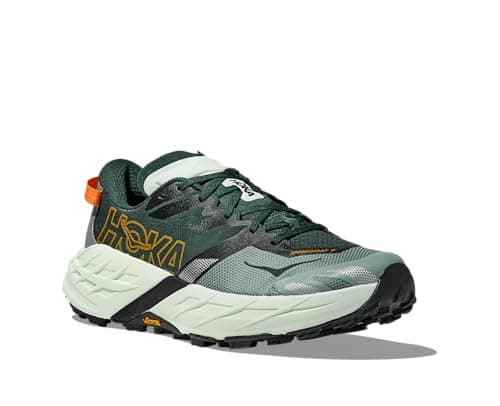
Hoka Speedgoat 7
Long trail days, ultras and fast hiking on mixed terrain
Pros
- ✓Deep, lively supercritical EVA cushioning
- ✓Vibram Megagrip is excellent on wet rock
- ✓Lightest Speedgoat to date
- ✓Available in narrow, regular and wide fits
Cons
- ✕Runs around half a size small
- ✕Less secure than the Speedcross in deep mud
- ✕Tall stack takes getting used to on off-camber ground
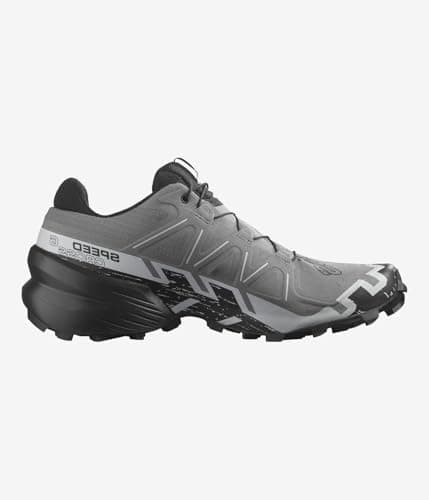
Salomon Speedcross 6
Muddy, soft and steep trails in wet climates
Pros
- ✓Class-leading grip in mud and soft ground
- ✓Snug, precise fit with Quicklace
- ✓Lugs shed mud well
- ✓Wide version available for men
Cons
- ✕Firm and harsh on hard trails and tarmac
- ✕Soft lugs wear quickly on rock
- ✕Narrow forefoot on the standard width
Kaha 3 GTX vs X Ultra 5 Mid GTX
For hiking boots, Hoka's flagship is the Hoka Kaha 3 GTX. It's a full-on cushioned mid boot with a Gore-Tex Invisible Fit lining, a Vibram Megagrip outsole and a stack north of 40 mm at the heel. At around 550 g per boot (RunRepeat's measurement), it's the heavier, more protective option, and it's one of the priciest boots in either range.
The Salomon X Ultra 5 Mid GTX is roughly 110 g lighter per boot and noticeably closer to the ground. It moves more like a hiking shoe with ankle coverage, with a lab-measured toe box that fits medium feet well and a wide version for everyone else. If you carry heavier loads, the Salomon Quest Element GTX is the more supportive Salomon alternative.
Kaha 3 GTX vs X Ultra 5 Mid GTX
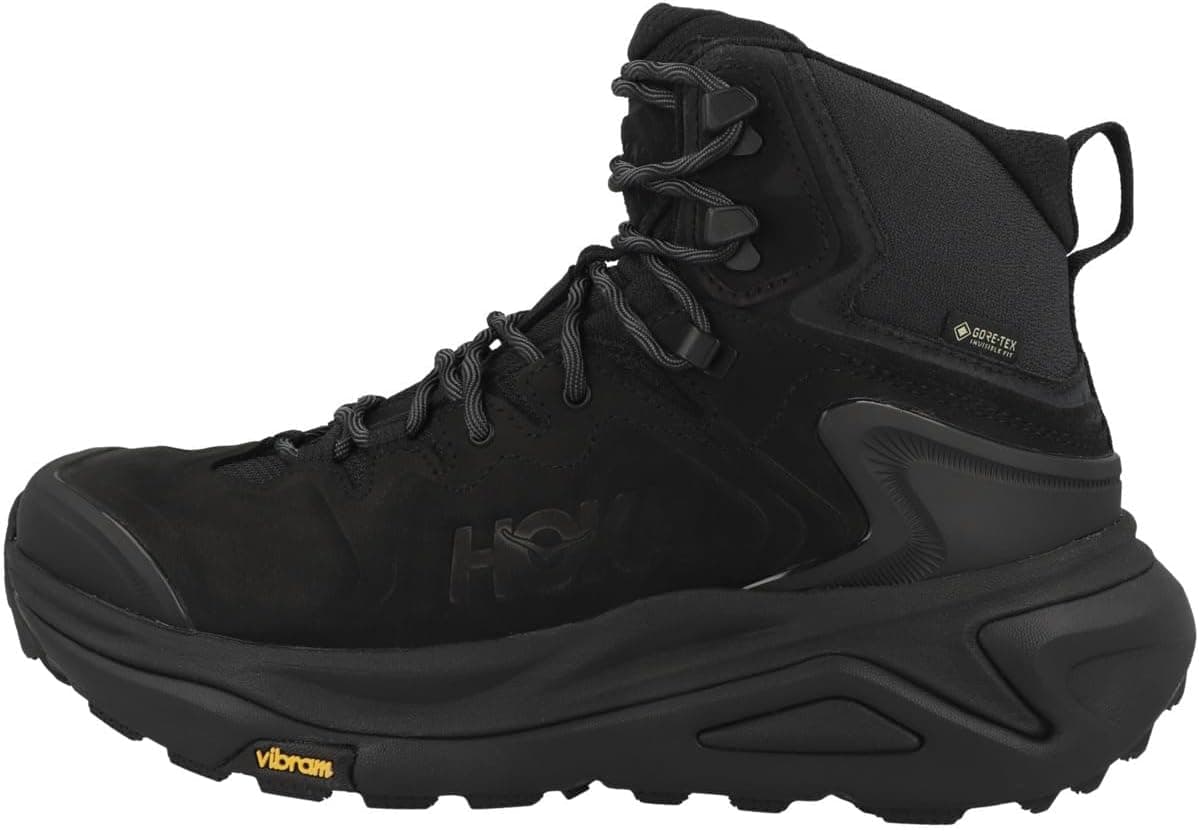
Hoka Kaha 3 GTX
Backpacking and long days on hard, rocky trails
Pros
- ✓Exceptional cushioning for long, hard descents
- ✓Gore-Tex Invisible Fit breathes better than standard GTX
- ✓Vibram Megagrip outsole
- ✓Rocker keeps a heavy boot rolling smoothly
Cons
- ✕Heavy for a modern hiking boot
- ✕Premium price
- ✕Tall platform feels less precise on scree
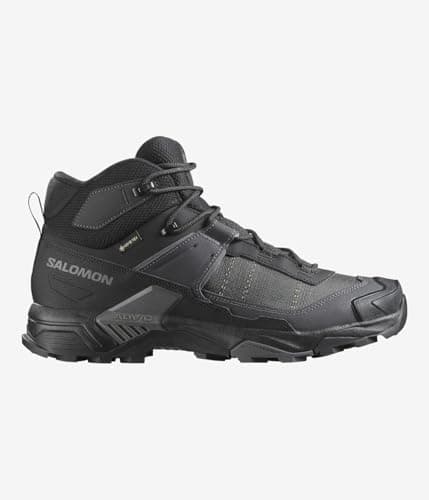
Salomon X Ultra 5 Mid GTX
Day hikes and light overnighters on varied ground
Pros
- ✓Lighter and more agile than most mid boots
- ✓Stable, ground-connected feel on technical terrain
- ✓Wide version available
- ✓Barely needs breaking in
Cons
- ✕Less cushioning on long descents
- ✕Slim ankles can struggle to get a secure lockdown
- ✕Not designed for heavy multi-day loads
Anacapa 2 Low GTX vs X Ultra 5 GTX
In low-cut waterproof hiking shoes, the Hoka Anacapa 2 Low GTX is the comfort pick. It has a cushioned midsole, Gore-Tex Invisible Fit and a wide option, which matters because the regular width runs narrow. It also earns a spot in our guide to the best comfortable hiking shoes.
The Salomon X Ultra 5 GTX is the low-cut version of Salomon's best-known hiker and the nimbler, slightly cheaper alternative. At around 377 g it's light, its Contagrip outsole with 4 mm lugs holds well on wet rock, and the firmer, lower ride suits shorter, rockier day hikes where you want to feel the ground.
Challenger 8 vs XA Pro 3D V9
These two cover the "one shoe for everything" brief. The Hoka Challenger 8 is a road-to-trail shoe: soft, light (around 270 g) and happiest on gravel, towpaths and easy forest trails. Its shallow lugs and exposed foam limit it on wet rock and mud.
The Salomon XA Pro 3D V9 is the opposite: a structured, supportive trail shoe with a stiff chassis, Quicklace and a lab-measured 12.5 mm drop. It's heavier at about 346 g, but far more stable when you're carrying a pack over rough ground, and there's a GTX version for wet weather.
Hoka vs Salomon Comparison Table
| Match-up | Hoka | Salomon | Better for |
|---|---|---|---|
| Trail running | Speedgoat 7: max cushion, 5 mm drop, Vibram Megagrip | Speedcross 6: deep mud lugs, 10 mm drop | Hoka for distance, Salomon for mud |
| Mid hiking boot | Kaha 3 GTX: about 550 g, very cushioned | X Ultra 5 Mid GTX: about 437 g, agile | Hoka for comfort, Salomon for agility |
| Low waterproof hiker | Anacapa 2 Low GTX: plush, wide option | X Ultra 5 GTX: firmer, lighter | Hoka for long days, Salomon for rocky ground |
| Do-it-all shoe | Challenger 8: light, road-to-trail | XA Pro 3D V9: supportive, stable | Hoka for easy trails, Salomon for rough ground |
| Fit | Roomy heel, many wide options | Snug, narrow to medium | Hoka for wide feet |
| Waterproof range | Smaller, Gore-Tex Invisible Fit | Large, GTX across most lines | Salomon |
Weights are men's figures from RunRepeat lab tests or manufacturer specs, so expect small differences between sizes.
Price and Value
Hoka is generally the more expensive brand. Its trail runners usually sit in the $150 to $170 range and the Kaha 3 GTX is well above $200. Salomon's trail runners and hiking shoes cluster between roughly $130 and $190, with frequent discounts on previous colourways.
Value depends on how long the shoe stays good. A Hoka that keeps your legs fresh over 30 km days earns its price. A Salomon that lasts longer on rough terrain and costs less to begin with is the smarter buy for shorter, technical hikes. If you're shopping on a tight budget, our list of cheap trail running shoes has strong alternatives from both brands' rivals.
Which Is Better, Hoka or Salomon? Verdict by Hiker Type
Choose Hoka if:
- You hike long distances or thru-hike and want maximum comfort
- You have knee, hip or foot pain and benefit from extra cushioning
- Your trails are mostly groomed paths, gravel or hard-packed dirt
- You have wide feet and want plenty of wide-width options
- You come from road running and like a soft, rolling ride
Choose Salomon if:
- You hike or run in mud, wet grass or soft ground
- Your routes include scree, steep ascents or scrambling
- You have narrow to medium feet and like a locked-in fit
- You want the widest choice of waterproof boots and shoes
- You prefer feeling the trail and want a stable, low platform
The honest answer: many experienced hikers own one of each. A Hoka for long, easy days and a Salomon for wet or technical routes covers almost every trail you'll face. If you're also weighing up Salomon against a more traditional hiking brand, our Salomon vs Merrell comparison is the next read. For a primer on stack height, drop and lugs, start with our trail running shoe guide.
Frequently Asked Questions

Jasper Baetens
Hiking enthusiast from Belgium, mainly active in Europe. Created HikeHeaven to share experiences, research, tips, tricks and recommend products — or simply to help other hikers.