Salomon vs Merrell: Which Hiking Shoes Are Better?
Salomon vs Merrell compared: X Ultra 5 vs Moab 3, boots, trail runners, fit, grip and value. Find out which brand suits your feet and your trails.

Salomon vs Merrell comes down to one trade-off: Salomon makes lighter, more precise shoes with a snug, technical fit, while Merrell makes roomier, cheaper shoes that feel comfortable from the first step. If you have narrow to medium feet and hike rocky, technical ground, Salomon usually wins. If you have wider feet, want zero break-in or need to keep the budget under $120, Merrell is the safer bet.
That's the short answer. The longer one depends on which models you're actually comparing, because both brands sell everything from $100 day hikers to burly backpacking boots. Below you'll find the brands head to head on fit, grip, waterproofing and durability, then five direct model match-ups, starting with the big one: the Salomon X Ultra 5 vs the Merrell Moab 3.
Brand Overview
Both brands are giants of hiking footwear, but they come from very different places, and you can still feel that heritage in the shoes.
Salomon: Alpine Precision
Salomon was founded in 1947 in Annecy, in the French Alps, and built its name on skis and bindings before moving into footwear. Today it's one of the biggest names in trail running and lightweight hiking, and that running DNA shapes almost everything it makes.
Salomon shoes tend to be light and locked-in, with a firm ride. The brand relies on in-house tech: Contagrip rubber outsoles, a chassis between midsole and outsole for stability, and Quicklace speed laces on many models. Our Salomon vs Columbia comparison shows the same thing: footwear is where Salomon is strongest.
Merrell: Comfort for Everyone
Merrell started in 1981, building on Randy Merrell's handmade backpacking boots from Utah. Its breakthrough came with the Moab, short for "Mother of All Boots", which grew into one of the best-selling hiking shoes in the world.
Merrell's approach is comfort and accessibility first. Its shoes use a roomier last (the foot-shaped mould a shoe is built around), plenty of padding, and Vibram rubber outsoles rather than an in-house compound. Prices start lower, too, which is why the Moab regularly tops lists of the best cheap hiking shoes.
Salomon vs Merrell Hiking Shoes: Head to Head
Here's how the two brands compare on the things that actually matter on the trail.
Fit and Width
This is the biggest difference, and the one that should drive your decision. Salomon shoes have a narrow heel and midfoot with a tapered toe box. Independent lab measurements of the X Ultra 5 GTX put its toe box at around 70 mm wide at the big toe, against roughly 75 mm for the Moab 3. Five millimetres doesn't sound like much, but on a long descent your toes will notice.
Merrell's Moab range is noticeably roomier and comes in wide sizes for both men and women across most versions. Salomon offers wide versions of the X Ultra 5 and a few other models, but plenty of its range (the Quest Element GTX, for example) only comes in standard width. If you've struggled with tight shoes before, our guide to the most comfortable hiking shoes covers more brands with generous fits.
Sizing
Merrell's low Moab 3 generally runs true to size. Salomon's X Ultra 5 fits snugly, and many hikers find it runs about half a size small, so size up if you're between sizes or wear thick socks. Some reviewers also report the Moab 3 Mid GTX running a touch small, so try boots on with your hiking socks whichever brand you pick.
Comfort and Break-In
Merrell wins on day-one comfort. The Moab 3 has thick padding around the collar and tongue and needs essentially no break-in. Salomon's shoes feel firmer underfoot from the start and stay that way, which some hikers love for stability and others find harsh on long, flat days.
Synthetic Salomon shoes like the X Ultra 5 still need only a short break-in. Leather-heavy boots like the Quest 4 GTX take longer. Our guide on how to break in hiking boots walks you through the process.
Grip: Contagrip vs Vibram
Salomon uses its own Contagrip rubber, with different compounds and lug patterns for each model. Merrell uses Vibram outsoles, mostly the TC5+ compound on hiking shoes and Megagrip on trail runners.
Both are excellent. In practice, Salomon's All Terrain Contagrip on the X Ultra 5 gives you precise, confident grip on wet rock and technical terrain, helped by the stiff chassis. The Moab 3's Vibram TC5+ has deeper lugs (around 5 mm against 4 mm), so it bites slightly better in loose dirt, while the Salomon feels more planted on rock slabs.
Waterproofing
Salomon uses Gore-Tex on almost all its waterproof hiking models (look for "GTX" in the name). Merrell offers two options on the Moab: Gore-Tex versions and cheaper "Waterproof" versions using Merrell's own M Select DRY membrane. The house membrane keeps water out on most day hikes, but Gore-Tex has the better track record for long-term breathability and reliability. If you buy Merrell for wet climates, it's worth paying the extra for the GTX version.
Durability
Salomon uppers on the X Ultra 5 use tough, reinforced synthetic materials with a protective toe cap, and the Contagrip outsole holds up well on hiking models. Salomon's softer trail-running rubbers, such as the Speedcross, wear faster if you walk them on pavement.
The Moab 3 mixes suede and mesh, and the exposed mesh panels are the first thing to scuff on abrasive rock. Its Vibram outsole is durable for the price. Expect both brands' low hikers to last somewhere around 500 to 800 km depending on terrain and your weight.
Price and Value
Merrell is cheaper at almost every level. The standard Moab 3 is often available for well under $120, while the X Ultra 5 GTX sits closer to $170. Merrell's Gore-Tex models close the gap but still usually undercut the equivalent Salomon.
Salomon vs Merrell: Hiking Footwear
Salomon
Narrow to medium feet, technical and rocky trails
Pros
- ✓Lighter shoes and boots across most of the range
- ✓Precise, locked-in fit for technical terrain
- ✓Gore-Tex on almost every waterproof model
- ✓Stiff chassis gives excellent stability on rock
- ✓Strong trail running heritage and range
Cons
- ✕Narrow fit doesn't suit wide feet
- ✕Firmer ride can feel harsh on long, flat days
- ✕Higher prices, especially for boots
Merrell
Wider feet, beginners and budget-conscious hikers
Pros
- ✓Roomy toe box and wide sizes on most models
- ✓Comfortable straight out of the box
- ✓Vibram outsoles with deep lugs
- ✓Lower prices across the range
- ✓Choice of Gore-Tex or cheaper house waterproofing
Cons
- ✕Heavier than equivalent Salomon models
- ✕Less precise on technical, off-camber ground
- ✕Exposed mesh scuffs on abrasive rock
Model Match-Ups
Brand reputation only gets you so far. Here's how the most popular models compare directly.
Merrell Moab 3 vs Salomon X Ultra 5
These are the two best-selling hiking shoes on the market, and they're the comparison most people actually mean when they search for Salomon vs Merrell.
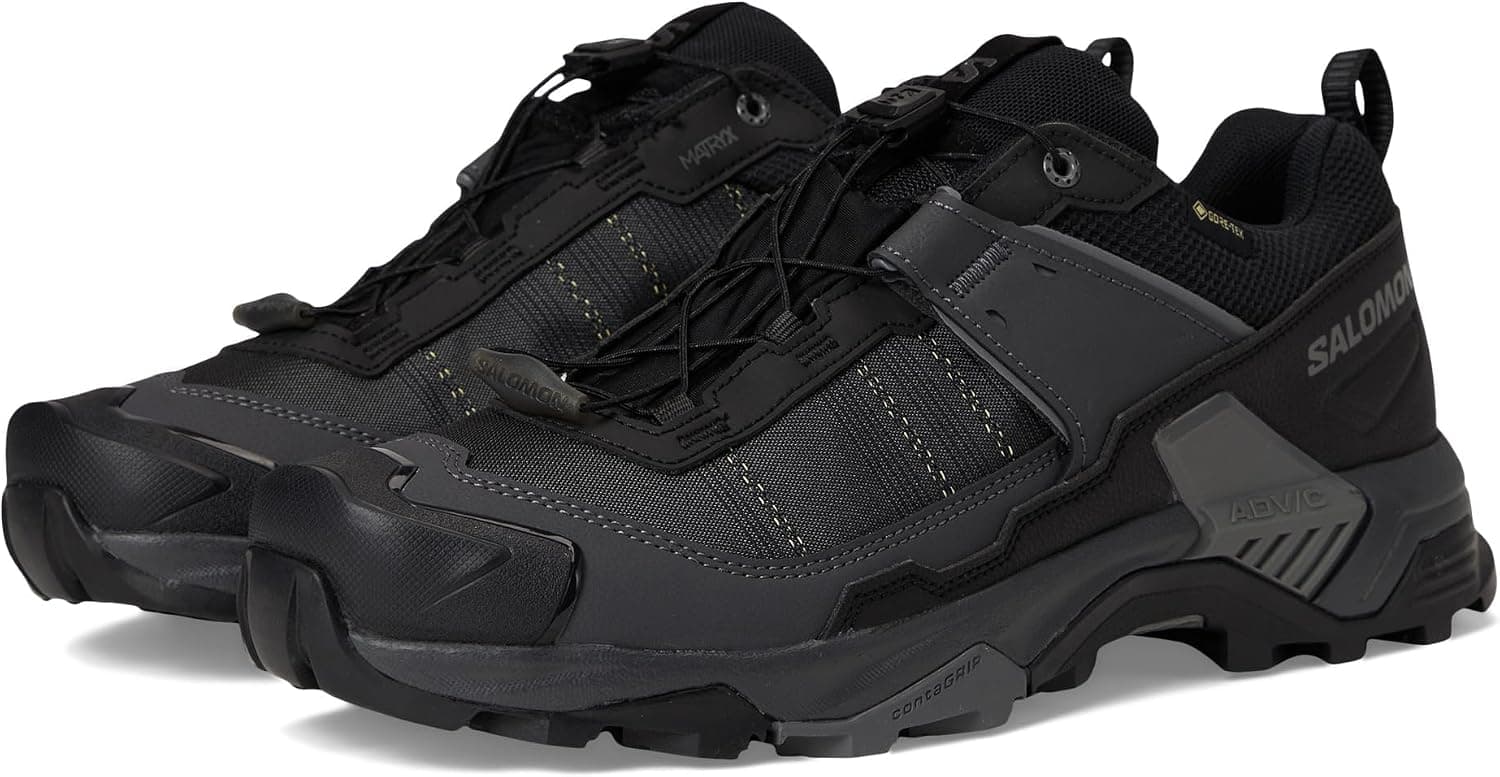
The Salomon X Ultra 5 GTX is the lighter, sportier shoe. It weighs around 377 g per shoe, comes with Gore-Tex as standard, and has Salomon's chassis for a stable, planted feel on uneven ground. The fit wraps your foot tightly and the ride is firm. It's built for hikers who move fast on rocky trails.
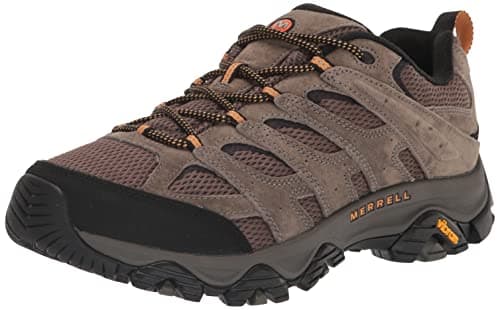
The Merrell Moab 3 is heavier at roughly 450 g per shoe in its standard version, but it's softer and roomier, and it costs less. The breathable mesh version suits summer hiking, and you can step up to the Moab 3 GTX if you need waterproofing. It's the shoe to buy if comfort and value matter more than precision.
Anchor Match-Up: X Ultra 5 GTX vs Moab 3
Salomon X Ultra 5 GTX
Fast hiking on technical trails
Pros
- ✓Light at around 377 g per shoe
- ✓Gore-Tex waterproofing as standard
- ✓Excellent stability on rocky, uneven ground
- ✓Quicklace system for fast, even tightening
Cons
- ✕Narrow toe box
- ✕Runs about half a size small
- ✕Firm ride with little softening over time
Merrell Moab 3
Comfort-first day hiking on a budget
Pros
- ✓Zero break-in, comfortable from day one
- ✓Roomy toe box with wide sizes available
- ✓Vibram TC5+ outsole with deep lugs
- ✓Very breathable non-waterproof version
Cons
- ✕Heavier and bulkier on the foot
- ✕Less precise on off-camber terrain
- ✕Mesh panels scuff on abrasive rock
Salomon X Ultra 5 Mid GTX vs Merrell Moab 3 Mid GTX
Want ankle coverage? The mid-cut versions follow the same pattern. The Salomon X Ultra 5 Mid GTX weighs around 437 g per boot, while the Merrell Moab 3 Mid GTX comes in at roughly 495 g. Both use Gore-Tex.
The Salomon is the better boot for rocky terrain and faster days, and it's the pick in our best Salomon hiking shoes guide for most hikers. The Merrell has more padding, more toe room and a gentler price, which makes it a great first waterproof boot for wet, moderate trails.
Salomon Quest Element GTX and Quest 4 GTX vs Merrell Moab Speed 2 Mid GTX
Once you move into proper boots, the brands drift apart. Salomon's Quest range covers heavier loads, and Merrell doesn't have a direct Quest 4 rival.
The Salomon Quest Element GTX weighs about 505 g per boot and gives you more support than the X Ultra without much extra weight. Read our full Salomon Quest Element GTX review for the details. The Salomon Quest 4 GTX goes further: at around 663 g per boot, it's a stiff, supportive backpacking boot built for multi-day trips with a heavy pack.
Merrell's closest answer is the Merrell Moab Speed 2 Mid GTX. It takes a different approach, with soft, thick FloatPro foam, a FlexPlate for stability and a Vibram TC5+ outsole, all in a light, sneaker-like mid boot. It's lovely for long day hikes with a light pack, but it won't support a 15 kg load like a Quest. For heavy backpacking, Salomon is the clear winner here.
Salomon XA Pro 3D V9 vs Merrell Moab Speed 2
These two sit between hiking shoe and trail runner. The Salomon XA Pro 3D V9 weighs around 346 g, has a 3D chassis for torsional stiffness and Quicklace, and comes in wide versions. It's stable and protective but firm.
The Merrell Moab Speed 2 is lighter at around 329 g, with much more cushioning (close to 39 mm of stack at the heel in lab tests) and a roomier toe box. If you want a plush, fast hiker for well-maintained trails, choose the Merrell. If you need a stable shoe for rough ground, the Salomon handles it better.
Salomon Speedcross 6 vs Merrell Agility Peak 6
For trail running, the Salomon Speedcross 6 is the mud specialist. Its Mud Contagrip outsole has aggressive chevron lugs close to 6 mm deep, which bite hard into mud, wet grass and soft ground. The trade-off is poor breathability and lugs that wear quickly on hard surfaces.
The Merrell Agility Peak 6 is the better all-rounder for rocky, technical trails. It uses Vibram Megagrip with 5 mm lugs, adds a forefoot rock plate and weighs around 278 g. Unusually for Merrell, its toe box is narrow, so it fits more like a Salomon than a Moab. Our trail running shoes guide explains how to match lugs to terrain.
Salomon vs Merrell Comparison Table
| Category | Salomon | Merrell |
|---|---|---|
| Fit | Narrow, snug, locked-in | Roomy, especially in the toe box |
| Wide sizes | Some models (X Ultra 5, XA Pro 3D) | Most Moab versions, men's and women's |
| Sizing | Runs snug, often half a size small | Generally true to size |
| Break-in | Short, but the ride stays firm | Almost none |
| Outsole | Contagrip (in-house) | Vibram TC5+ and Megagrip |
| Waterproofing | Gore-Tex | Gore-Tex or M Select DRY |
| Weight | Lighter | Heavier, except the Speed line |
| Low hiking shoes | Around $140 to $180 | Around $100 to $170 |
| Mid boots | Around $160 to $230 | Around $130 to $180 |
| Trail runners | Around $140 to $150 | Around $140 to $150 |
Prices are typical US retail ranges and move around a lot on Amazon. Merrell's Moab 3 in particular is often discounted.
Which Is Better, Merrell or Salomon?
Neither brand is better overall. Here's how to choose based on how you hike.
Choose Salomon if:
- You have narrow or medium-width feet
- You hike rocky, technical or steep terrain where stability matters
- You want the lightest shoe for the job
- You carry heavy loads and need a supportive boot like the Quest 4
- You prefer a firm, responsive feel underfoot
Choose Merrell if:
- You have wide feet or need a roomy toe box
- You're a beginner and want a comfortable shoe that works straight away
- You hike mostly on moderate, well-maintained trails
- You want to spend under $120
- You prefer soft cushioning over ground feel
Hikers who sit somewhere in the middle often end up with one of each: a Moab 3 for summer walks and a Salomon GTX boot for wet, rocky days. If you're also weighing up a maximalist alternative, our Hoka vs Salomon comparison covers the cushioned end of the market.
Frequently Asked Questions
Still deciding? Start with fit. Try on a Moab 3 and an X Ultra 5 back to back, and the one that feels right on a downhill is your answer. Then check our best Salomon hiking shoes or best cheap hiking shoes guides to find the exact model for your trails.

Jasper Baetens
Hiking enthusiast from Belgium, mainly active in Europe. Created HikeHeaven to share experiences, research, tips, tricks and recommend products — or simply to help other hikers.