Best Garmin Watch for Hiking: Tested Picks
Find the best Garmin watch for hiking, from the budget Instinct 2 to the expedition-grade Fenix 7X Solar. Picks for every type of hiker.

Garmin makes the best GPS watches for hiking. That's a strong claim, but after years of testing them on everything from weekend day hikes to multi-week mountain expeditions, it holds up. The harder question is finding the best Garmin watch for hiking your way, because there's a real gap between a $300 Instinct 2 and a $900 Fenix 7X Solar, and buying the wrong one is an expensive mistake.
This guide covers four models across the full range: what they do well, where they fall short, and exactly which type of hiker should buy each one. There's also a section on the Instinct 2 vs Fenix 7 debate, the most common question I see from people who've narrowed it down to two.
Which Hiker Needs Which Garmin?
Before getting into individual models, it helps to know where you sit. These three profiles cover most hikers.
Casual day hiker: You hike 10-20 times a year, mostly marked trails, day trips or occasional overnighters. You want GPS tracking, a basic map view, and battery that lasts the full day. You don't need topographic maps or multi-week battery life. The Instinct 2 is your watch.
Regular hiker and backpacker: You hike most weekends, take 3-7 day routes, and want your watch to genuinely help you navigate. Topographic maps, turn-by-turn navigation, and 2-3 week battery in GPS mode matter to you. The Fenix 7 is your watch.
Trail runner or fast-packer: You cover ground quickly and want accurate pace and elevation data alongside the GPS features. The Forerunner 955 Solar sits at the overlap of serious running metrics and solid hiking features.
Expedition hiker: You do multi-week routes, remote wilderness travel, or winter mountaineering. Battery life measured in weeks (not days) and a device that keeps working in -20°C matters. The Fenix 7X Solar or Enduro 2 is your watch.
Best Budget Garmin for Hiking: Instinct 2
The Garmin Instinct 2 ($300) is the easiest recommendation in this guide. It's rugged, accurate, and keeps going long after most other watches are dead. The standard model runs 28 days in smartwatch mode and up to 30 hours in GPS mode. The Solar variant extends both figures: up to 54 days smartwatch mode and unlimited battery with sufficient sunlight exposure.
The display is a 0.9" monochrome LCD, which sounds basic until you're outside in full sun and every other watch is unreadable. The Instinct 2's screen is clear in direct sunlight at a glance. It's also genuinely rugged: MIL-STD-810 tested for temperature, humidity, shock, and vibration, with 100m water resistance.
Features include 3-axis compass, barometric altimeter, GPS/GLONASS/Galileo multi-GNSS, and ABC sensors (altimeter, barometer, compass). You get basic navigation with TracBack (retracing your route), breadcrumb maps, and waypoint marking. What you don't get: full topographic maps, colour display, music storage, or the detailed turn-by-turn navigation of the Fenix range.
For battery life context, the Garmin battery life overview covers the full numbers across every mode in detail.
Best Mid-Range Garmin for Hiking: Fenix 7
The Fenix 7 ($700) is a proper step up in capability. The big addition over the Instinct range is full topographic maps with turn-by-turn navigation. Load your route as a GPX file, and the Fenix 7 guides you along it with distance to next waypoint, bearing, and a moving map showing your position on the topo. For navigation in unfamiliar terrain, this is transformative.
Battery life is strong: 18 days in smartwatch mode, 57 hours in GPS mode, and 73 hours with multi-GNSS. The 1.3" sunlight-visible colour display is readable in bright conditions. The Fenix 7 also adds music storage (up to 500 songs), contactless payments, and a full suite of health monitoring including pulse ox, body battery, and HRV status.
The Solar variant of the Fenix 7 adds solar charging panels embedded in the display lens, extending GPS mode battery to 89 hours under ideal conditions. For most hikers the standard Fenix 7 is enough. You'd need multi-day routes in full sunlight to notice meaningful solar gain.
For anyone planning extended backcountry trips, the watch pairs naturally with satellite communication. The Garmin inReach Mini 2 integrates directly with Fenix watches for two-way messaging and SOS without a separate device.
Best Garmin for Trail Running and Hiking: Forerunner 955 Solar
The Forerunner 955 Solar ($500) occupies a useful position in the Garmin range: it's lighter than the Fenix (52g vs 79g), has the same multi-GNSS GPS accuracy, and adds running-specific metrics the Fenix doesn't match.
For trail runners who also hike, the 955 Solar is the better pick. It includes VO2 max, training load, training effect, and accurate pace metrics on varied terrain that the Instinct and Fenix watches don't match. The race predictor and recovery advisor features are taken seriously here rather than being secondary additions.
On the hiking side, you still get topographic maps, turn-by-turn navigation, barometric altimeter, 3-axis compass, and a sunlight-readable colour display. Battery life is 20 days smartwatch and 49 hours in GPS mode, extending to unlimited in solar-favourable conditions.
The trade-off is durability. The Forerunner case is lighter and less rugged than the Fenix series. It's not MIL-STD rated, so for expedition use or technical mountain environments, the Fenix's durability advantage matters. For a day hiker or trail runner, this isn't a concern.
Best Premium Expedition Watch: Fenix 7X Solar and Enduro 2
For multi-week expeditions and remote wilderness travel, battery life becomes a constraint everything else bends around. Two watches sit at the top of Garmin's range for this purpose.
Fenix 7X Solar
The Fenix 7X Solar ($900) uses a larger 1.4" display and expanded solar panel area compared to the standard Fenix 7 Solar. In GPS mode with solar, it extends to 122 hours, over five days of continuous GPS tracking. In smartwatch mode it reaches 37 days. The larger case (51mm vs 47mm) is noticeable on the wrist, but hikers doing 3-week expeditions generally consider the battery trade-off worth it.
Features are identical to the Fenix 7: full topo maps, music, payments, health monitoring, and the full sensor suite. The X model adds a built-in LED torch on the bezel, which is practical in a tent or when fumbling with kit at 3am.
Enduro 2
The Enduro 2 ($800) takes a different approach: strip out the premium materials (sapphire lens, titanium case) in favour of an oversized solar panel optimised for ultra-endurance events. Battery in GPS mode reaches 150 hours. In activity mode with solar, Garmin claims unlimited battery with sufficient sun exposure.
The Enduro 2 runs most of the same software as the Fenix range, including topo maps and navigation. It's the better choice if raw battery life is the priority and you prefer the lighter, more minimal aesthetic. The Garmin expedition mode guide explains how to configure either watch to maximise battery on long routes.
Garmin Instinct 2 vs Fenix 7: Which to Choose?
This is the most common question in the Garmin range, and the answer comes down to two things: maps and money.
If you want full topographic maps with turn-by-turn navigation on trail, get the Fenix 7. The Instinct 2's breadcrumb map and TracBack are useful but not comparable to seeing your route on a proper topo map with contour lines.
If you don't need maps, the Instinct 2 does everything else remarkably well for $400 less. The GPS accuracy and sensor suite are comparable. The battery life is comparable (and the Solar variant is arguably better for day-to-day use). The display and build quality are different but the Instinct's monochrome display is genuinely more readable in daylight.
A practical test: on your last three hikes, did you use digital maps at all? If the answer is no, the Instinct 2 is the right call. If you're navigating unfamiliar terrain or relying on your watch for route-finding, the Fenix 7 is worth the premium.
For a full breakdown including the tactical variants, see the Garmin Instinct vs Fenix comparison and the detailed Garmin stealth mode guide if you're looking at the tactical editions.
Garmin Watches for Hiking: Head to Head
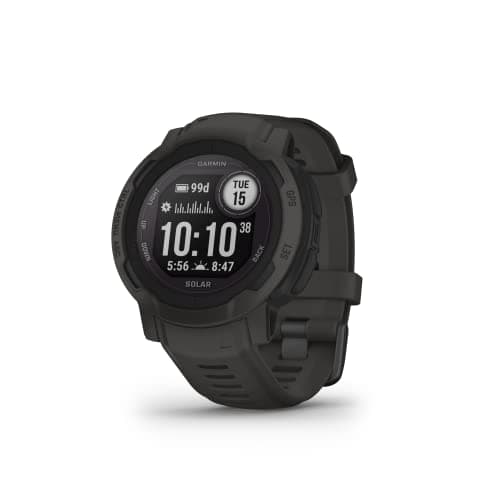
Garmin Instinct 2S Solar
$350
?Estimated price — check latest price on Amazon
Casual to regular day hikers who want a compact case and long battery without the premium price
Pros
- ✓Smaller 40mm case for narrower wrists
- ✓Solar-assisted battery, unlimited in strong sun
- ✓MIL-STD-810 rated ruggedness
- ✓Excellent sunlight readability
Cons
- ✕No topographic maps
- ✕Monochrome display only
- ✕No music storage or contactless payments
Garmin Fenix 7
$700
?Estimated price — check latest price on Amazon
Regular hikers and backpackers who want full navigation capability
Pros
- ✓Full topographic maps with turn-by-turn navigation
- ✓Colour sunlight-readable display
- ✓Music storage up to 500 songs
- ✓57-hour GPS battery, 18-day smartwatch
Cons
- ✕Significantly higher price
- ✕Heavier than Forerunner range
- ✕Solar gain minimal in most real-world conditions
Garmin Forerunner 955 Solar
$500
?Estimated price — check latest price on Amazon
Trail runners who also hike and want serious pace and training metrics
Pros
- ✓Best running metrics in the Garmin hiking-capable range
- ✓Lighter than Fenix at 52g
- ✓Full topo maps and navigation
- ✓49-hour GPS battery
Cons
- ✕Less rugged than Fenix or Instinct
- ✕Running focus means some hiking features are secondary
- ✕Smaller solar panel than 7X Solar
Garmin Fenix 7X Solar
$900
?Estimated price — check latest price on Amazon
Expedition hikers, multi-week routes, and remote wilderness travel
Pros
- ✓122-hour GPS battery with solar
- ✓Built-in LED torch
- ✓Largest solar panel in the Fenix 7 range
- ✓Full feature set: maps, music, payments, health
Cons
- ✕Largest and heaviest option at 89g
- ✕Premium price for most hikers
- ✕51mm case is large on smaller wrists
Does a Hiking Watch Replace a Dedicated GPS Device?
For most hiking, yes. Modern Garmin watches with topo maps (Fenix 7 and above) provide the same maps, routing, and navigation features as a standalone GPS unit. The Fenix 7 and 7X Solar run the same BaseCamp-compatible maps you'd load onto a Garmin Oregon or GPSMAP device.
Where dedicated GPS units still have an edge: battery life measured in AA batteries (replaceable in the field), larger screens, and more comfortable one-handed operation on a mounted device. For technical navigation in poor conditions, a GPSMAP 67i with a 3" screen is easier to read than a watch.
For most recreational hikers and backpackers, the Fenix 7's on-wrist navigation is sufficient and more practical. You'll consult it dozens of times per hour without stopping to pull out a device.
Key Features to Look For in a Hiking GPS Watch
GPS accuracy: All Garmin hiking watches support multi-GNSS (GPS + GLONASS + Galileo). The Fenix 7 and Forerunner 955 also support dual-frequency GPS, which provides better accuracy in deep valleys and tree cover by using two GPS signals simultaneously. For most hiking, standard multi-GNSS is fine. For technical navigation in complex terrain, dual-frequency is worth having.
Battery life: Match it to your longest unsupported trip. If you're never out more than a day, the Instinct 2's 30-hour GPS mode is generous. If you do 5-7 day routes, the Fenix 7's 57-hour GPS mode becomes the constraint. Multi-week expeditions need the Fenix 7X Solar or Enduro 2.
Altimeter and barometer: All four watches covered here use barometric altimeters (not GPS elevation, which is less accurate). The barometer doubles as a weather indicator; dropping pressure signals incoming weather. For mountain hiking, this is useful safety information.
Maps: The dividing line in the Garmin range. Instinct 2 has breadcrumb maps and TracBack but no topo. Fenix 7 and above have full downloadable topographic maps. If you navigate by map, this matters a lot.
Weight: Instinct 2 at 52g. Fenix 7 at 79g. Forerunner 955 at 52g. Fenix 7X Solar at 89g. You feel the difference on long days. Trail runners especially notice the lighter options.
What You Get at Each Price Point
- Multi-GNSS GPS tracking
All four watches support GPS, GLONASS, and Galileo for accurate tracking across all conditions. Dual-frequency adds another level of accuracy on the Fenix 7 and Forerunner 955.
- Barometric altimeter and compass
A barometric altimeter is more accurate than GPS elevation and doubles as a weather indicator. Present on all watches in this guide.
- Topographic maps with turn-by-turn navigation
Available on Fenix 7, Forerunner 955 Solar, and Fenix 7X Solar. Absent on the Instinct range. The single biggest functional difference between budget and mid-range Garmin watches.
- Solar charging
Available on all Solar variants. Extends battery meaningfully only with sustained direct sunlight. Most useful in summer at high altitude or in desert environments.
- Satellite messaging integration
Via Garmin inReach Mini 2. Pairs with Fenix and Instinct watches for two-way SOS and messaging. Requires a separate device and subscription, but the watch integration is seamless.
The best Garmin watch for hiking depends on what you're actually doing on trail. The Instinct 2 handles the vast majority of hiking needs at a price that doesn't require justification. Step up to the Fenix 7 when you need proper map navigation. Consider the 7X Solar or Enduro 2 only when expedition battery life becomes the constraint.
For anyone heading into remote terrain, pair whichever watch you choose with a satellite communicator for hiking. The watch handles navigation, the communicator handles safety. That combination covers you more completely than any single device.
Last updated on June 21, 2026.

Jasper Baetens
Hiking enthusiast from Belgium, mainly active in Europe. Created HikeHeaven to share experiences, research, tips, tricks and recommend products — or simply to help other hikers.