Garmin Instinct vs Tactical: What's Actually Different?
Garmin Instinct vs Tactical: same hardware, different software. Compare the six tactical-only features and find out if the extra cost is worth it for hikers.


The Garmin Instinct vs Tactical decision confuses a lot of people, and understandably so. The two watches look identical, share the same hardware, and sit on the same product page in many stores. The difference is entirely software. The Tactical edition includes six additional features designed for military and specialist users, and the question is whether any of those features justify the higher price tag for hikers and outdoor enthusiasts.
Same Watch, Different Software
Here's the fundamental thing to understand: the Garmin Instinct and Garmin Instinct Tactical use identical hardware. Same GPS chipset, same sensors, same screen, same battery, same case, same strap. This applies to both the original Instinct generation and the Instinct 2 generation.
The Tactical edition is a software upgrade. Garmin loads six additional features onto the watch, all of which are aimed at military and specialist operational use. You cannot unlock these features on a standard Instinct through a firmware update; they're exclusive to the Tactical SKU.
The Tactical edition typically costs around $100 more than the standard model, though pricing varies depending on the retailer and whether you're looking at the original Instinct or the Instinct 2S Solar.
The Six Tactical-Only Features
Here's each feature the Tactical edition adds, and, more importantly, whether any of them matter for hiking and outdoor recreation.
1. Stealth Mode
Stealth Mode disables all wireless communication and GPS position sharing simultaneously. When activated, the watch stops transmitting any data, stops recording your GPS track, and won't sync with your phone.
Why it exists: Military personnel operating in sensitive areas need to eliminate electronic signatures that could reveal their position.
For hikers: You can achieve roughly the same result by manually turning off Bluetooth and disabling GPS recording. It's a convenience toggle rather than a unique capability.
2. Night Vision Goggle Compatibility
This mode switches the display to a red-tinted, extremely dim backlight that won't interfere with night vision goggles (NVGs). Standard backlights produce enough light to temporarily blind NVG-equipped users.
Why it exists: Soldiers using night vision equipment in the field need to check their watch without compromising their vision or giving away their position.
For hikers: Unless you're hiking with military-grade night vision goggles, this feature has no practical application. A standard dim backlight setting works fine for night hiking.
3. Jumpmaster
The Jumpmaster feature is a skydiving computer. It supports three jump types: Static Line, HAHO (High Altitude High Opening), and HALO (High Altitude Low Opening). It calculates release points, tracks altitude during freefall, and provides navigation to the drop zone.
Why it exists: Military parachutists need precise jump calculations during airborne operations.
For hikers: This feature has zero relevance to hiking. If you're not jumping out of aircraft, you'll never open this screen.
4. Waypoint Projection
This is the one tactical feature that hikers might actually find useful. Waypoint Projection lets you create a new waypoint by entering a bearing (compass direction) and distance from your current position. The watch then calculates the coordinates of that projected point and can navigate you to it.
Why it exists: Military navigation often involves projecting positions from a known point using a compass bearing and distance from a paper map.
For hikers: If you practise traditional map-and-compass navigation, this feature has genuine value. You could plot a bearing from your position, project a waypoint at a specific distance, and use the watch to navigate there. It's particularly handy for off-trail navigation in poor visibility.
That said, most hikers navigate using tracks and trails loaded from apps like Komoot or AllTrails, which makes waypoint projection less critical than it would be for cross-country military movement.
5. Dual-Position GPS Formatting
This feature displays your GPS position in two coordinate formats simultaneously, for instance showing both MGRS (Military Grid Reference System) and standard latitude/longitude at the same time without toggling between screens.
Why it exists: Military operations frequently require positions in MGRS format, while air support or civilian coordination may need lat/long. Having both visible at once speeds up radio communications.
For hikers: Most hikers only need one coordinate format. You can change the format on the standard Instinct through settings. The Tactical edition simply lets you see two formats at once, which saves a few seconds at most.
6. Tactical Activity Mode
This is a dedicated activity profile that combines several tactical features into one streamlined interface. It shows your GPS coordinates in dual format, gives quick access to Stealth Mode, and provides a tactical-oriented data layout during your activity.
Why it exists: It bundles the other tactical features into a single, easily accessible mode during operations.
For hikers: It's essentially a custom activity profile. The standard Instinct allows you to customise data screens within its existing activity profiles, so this provides minimal additional value.
Garmin Instinct vs Tactical: Side-by-Side
Standard vs Tactical Edition
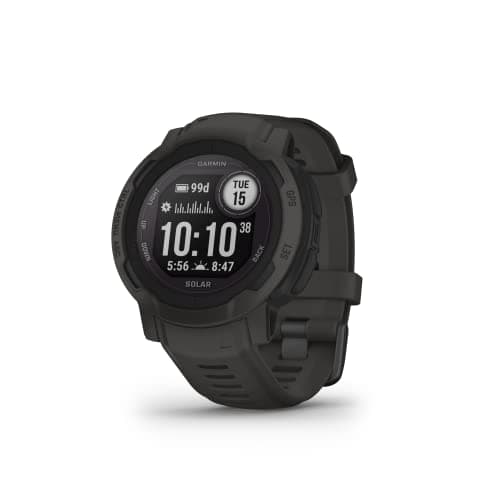
Garmin Instinct 2S Solar
$350
?Estimated price — check latest price on Amazon
Hikers, trail runners, and outdoor enthusiasts
Pros
- ✓Solar charging extends battery to unlimited (smartwatch mode)
- ✓Full GPS, barometric altimeter, and compass
- ✓All standard hiking and fitness features
- ✓Compact 40mm case and lower price point
Cons
- ✕No Waypoint Projection feature
- ✕No Stealth Mode toggle
- ✕No NVG-compatible display mode
- ✕Cannot display dual GPS formats simultaneously
Garmin Instinct 2 Solar Tactical
$450
?Estimated price — check latest price on Amazon
Military personnel and specialist users
Pros
- ✓All standard Instinct 2 features included
- ✓Solar charging for extended battery life
- ✓Waypoint Projection for bearing-based navigation
- ✓Stealth Mode for one-tap wireless shutdown
- ✓NVG compatibility, Jumpmaster, and dual-position GPS
Cons
- ✕Roughly $100 more expensive
- ✕Most tactical features irrelevant for hiking
- ✕Identical hardware to standard edition
- ✕Jumpmaster only useful for military parachutists
Which Garmin Instinct Should Hikers Choose?
For the vast majority of hikers, the standard Garmin Instinct 2S Solar is the better buy. You get the same hardware: the same GPS accuracy, the same altimeter, the same battery life, the same durability rating (MIL-STD-810). And you save roughly $100. If you're still weighing up models, our guide to the best Garmin watch for hikers covers the full range.
The tactical features are purpose-built for military operations. Jumpmaster, NVG compatibility, and Stealth Mode have no practical application on a hiking trail. Dual-position GPS formatting is a minor convenience at best. The only feature with genuine hiking relevance is Waypoint Projection, and even that only matters if you regularly navigate off-trail using bearing and distance rather than GPS tracks.
If you're interested in getting more from your Garmin on extended trips, have a look at our guide on Garmin expedition mode, which explains how to stretch battery life across multi-day hikes. For a full comparison of GPS hours and smartwatch battery across the Garmin range, our Garmin battery life overview puts every model side by side.
What About the Garmin Fenix Instead?
If you're spending $350-$450 on a Garmin Instinct 2 Solar Tactical, it's worth considering whether the Garmin Fenix 7 might be a better investment. The Fenix 7 starts at around $700, which is a significant step up in price, but it offers:
- A full-colour, higher-resolution display
- Touchscreen plus button navigation
- Full topographic maps on the watch
- More advanced training metrics
- A larger, more detailed interface
For hikers who want the absolute best GPS watch for trail navigation, the Fenix 7 is the gold standard. But if you prefer a rugged, no-frills tool that handles navigation, weather tracking, and basic fitness features without fuss, the Instinct 2S Solar at $350 is hard to beat.
Garmin Watch Recommendations for Hikers
- Garmin Instinct 2S SolarEssential
Best value for hikers. Solar charging, full GPS suite, barometric altimeter, and MIL-STD-810 durability in a compact 40mm case. All the features you need without paying for military software.
Premium option with full topographic maps, colour touchscreen, and advanced training features. The best hiking GPS watch available, at a premium price.
Only recommended for military, law enforcement, or specialist users who need Stealth Mode, NVG compatibility, or Jumpmaster.
The Verdict
The Garmin Instinct vs Tactical comparison boils down to one question: do you need military-specific software features? The hardware is identical. The six tactical features (Stealth Mode, NVG compatibility, Jumpmaster, Waypoint Projection, Dual-Position GPS and Tactical Activity Mode) are designed for combat and specialist operations. Waypoint Projection is the only one with genuine hiking utility, and it's a niche feature even then.
For hikers, the standard Garmin Instinct 2S Solar is the clear recommendation. You get the same rugged, reliable GPS watch for less money. Save the $100 and put it towards a pair of decent hiking socks instead.
Last updated on June 21, 2026.

Jasper Baetens
Hiking enthusiast from Belgium, mainly active in Europe. Created HikeHeaven to share experiences, research, tips, tricks and product recommendations, or simply to help other hikers.