Garmin Battery Life Overview: Every Watch Compared
Complete Garmin battery life comparison across 8 popular watches. GPS hours, smartwatch days, and solar figures to help you pick the right one.

Garmin battery life is the single biggest factor that separates a good hiking watch from a great one. Run out of power on day three of a five-day trek and your expensive GPS becomes a bracelet. The problem is that Garmin makes dozens of watches, each with different battery specs across multiple modes, and comparing them takes more patience than most people have. This guide puts every relevant number in one place so you can match the right watch to your trip length.
How Garmin Measures Battery Life
Before jumping into the numbers, it helps to understand what Garmin actually means by each mode. The company tests battery life under specific conditions, and real-world results depend on which features you've got running.
Smartwatch mode is everyday use: activity tracking, wrist-based heart rate, phone notifications, and time display. No active GPS. This is the "days between charges" figure.
GPS mode means continuous satellite tracking during an activity like hiking or running. The watch locks onto GPS satellites and records your position every second. This is measured in hours.
Max Battery GPS mode reduces the GPS sampling rate (recording a point every few minutes instead of every second) and disables some sensors. The track is less detailed, but battery life jumps significantly.
Expedition GPS mode is the most extreme power-saving option. The watch records one GPS point per hour, turns off the heart rate sensor, and goes into a low-power state between readings. Designed for multi-week expeditions where charging isn't an option.
Battery saver watch mode strips the watch down to basic timekeeping. No activity tracking, no heart rate, no notifications.
Garmin Battery Life Comparison Table
Here's the full breakdown across eight popular Garmin watches for hikers. All figures come from Garmin's official specifications.
| Watch | Smartwatch | GPS Only | Max Battery GPS | Expedition GPS | Price |
|---|---|---|---|---|---|
| Instinct 2 | 24 days | 30 hr | 70 hr | 32 days | $250 |
| Instinct 2S Solar | 21 days (51*) | 28 hr | 114 hr | 105 days* | $350 |
| Instinct Tactical | 16 days | 40 hr | N/A | N/A | $300 |
| Instinct 2 Tactical | 24 days | 30 hr | 70 hr | 32 days | $350 |
| Fenix 7 | 18 days (22*) | 57 hr (73*) | 136 hr (289*) | 40 days (74*) | $700 |
| Fenix 7X Solar | 28 days (37*) | 89 hr (122*) | 213 hr (578*) | 62 days (139*) | $900 |
| Forerunner 955 Solar | 15 days (20*) | 42 hr (49*) | 80 hr (110*) | N/A | $500 |
| Enduro 2 | 34 days (46*) | 110 hr (150*) | 264 hr (714*) | 77 days (172*) | $800 |
Solar figures assume 3 hours of daily sun at 50,000 lux.
Best Garmin Battery Life for Day Hikes
If your typical outing is 4 to 10 hours, battery life isn't a real concern with any current Garmin watch. Even the shortest-lived model in this comparison, the original Instinct Tactical at 40 hours of GPS, will comfortably last several day hikes between charges.
That said, there's a practical advantage to longer battery life even on day hikes: you don't need to charge as often. A watch with 57 hours of GPS life (like the Fenix 7) can handle three or four full-day hikes before it needs a cable. The Instinct 2 at 30 hours of GPS covers about two long hikes per charge.
For day hikers, any watch in this comparison will do the job. Pick based on features, comfort, and budget rather than battery anxiety. If you're still weighing up models, our guide to the best Garmin watch for hikers breaks down the wider trade-offs beyond battery.
Best Garmin Battery Life for Weekends and Multi-Day Treks
This is where battery differences start to matter. A two-day or three-day hike with 8 to 10 hours of daily GPS use demands 16 to 30 hours at minimum, and that's cutting it tight if you want a safety margin.
Here's how the maths works for a three-day trek with 8 hours of daily GPS use (24 hours total):
- Instinct 2: 30 hours GPS. Tight. You'd finish with roughly 6 hours to spare, assuming no overnight smartwatch drain.
- Instinct 2S Solar: 28 hours GPS with solar. Just enough, with solar topping up throughout the day.
- Fenix 7: 57 hours GPS. Plenty of headroom.
- Fenix 7X Solar: 89 hours GPS. More than three times what you need.
For weekend warriors and three-day hikers, the Instinct 2S Solar at $350 hits the sweet spot. It handles a long weekend in Max Battery GPS mode, the solar panel provides meaningful top-ups during the day, and the price doesn't push into Fenix territory. The 40mm case also suits smaller wrists better than the larger Instinct line.
Best Garmin Battery Life for Thru-Hikes and Expeditions
When you're on trail for a week or more without reliable access to power, battery life becomes the defining feature of your watch. This is where the Enduro 2 and Fenix 7X Solar pull ahead of everything else.
Let's put it in practical terms. On a seven-day trek with 8 hours of daily GPS:
- Instinct 2S Solar (Max Battery GPS): 114 hours with solar. That's about 14 eight-hour days, enough for most thru-hike legs between resupply.
- Fenix 7X Solar (GPS only): 122 hours with solar. About 15 days of 8-hour GPS use.
- Enduro 2 (GPS only): 150 hours with solar. Nearly 19 days of 8-hour tracking.
For truly long expeditions, the Expedition GPS mode changes the game entirely. The Enduro 2 lasts up to 172 days with solar in Expedition mode. That's over five months. The trade-off is a GPS point recorded only once per hour, which creates a very rough track. But for a multi-week thru-hike where you're following a well-marked trail, having any GPS record is better than running out of battery.
Top 3 Picks for Garmin Battery Life
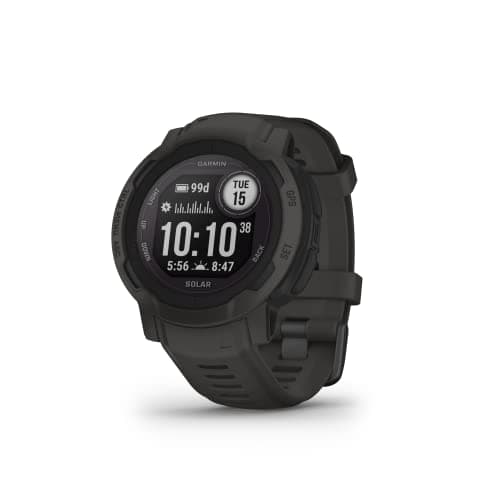
Garmin Instinct 2S Solar
$350
?Estimated price — check latest price on Amazon
Best value for multi-day hikers
Pros
- ✓51 days smartwatch battery with solar
- ✓28 hours GPS, 114 hours Max Battery GPS with solar
- ✓Rugged MIL-STD-810 build at $350
- ✓Compact 40mm case suits smaller wrists
Cons
- ✕Monochrome display, no maps
- ✕22 hours GPS without solar boost
- ✕No touchscreen navigation
- ✕Smaller battery than the 45mm Instinct 2 Solar
Garmin Fenix 7X Solar
$900
?Estimated price — check latest price on Amazon
Best all-round hiking GPS with long battery
Pros
- ✓89 hours GPS, 122 hours with solar
- ✓Full topographic maps on the watch
- ✓Colour touchscreen plus button controls
- ✓28 days smartwatch, 37 with solar
Cons
- ✕Premium price at $900
- ✕Heavier and bulkier than Instinct line
- ✕Overkill for casual day hikers
- ✕Solar gains depend on consistent sun exposure
Garmin Enduro 2
$800
?Estimated price — check latest price on Amazon
Best for thru-hikes and ultra-long expeditions
Pros
- ✓110 hours GPS, 150 with solar
- ✓77 days Expedition mode, 172 with solar
- ✓Full maps and multi-band GPS
- ✓264 hours Max Battery GPS mode
Cons
- ✕Most expensive at $800
- ✕51mm case is large for smaller wrists
- ✕Designed for ultra-endurance, not everyday use
- ✕Fewer smartwatch features than Fenix line
How Solar Charging Affects Garmin Battery Life
Solar charging sounds impressive on paper, and for some models it genuinely delivers. But the impact varies dramatically across the range.
The Instinct 2S Solar has one of the most dramatic solar benefits: smartwatch mode stretches from 21 to 51 days, and GPS mode jumps from 22 to 28 hours. That 27 percent GPS increase is meaningful for hikers, and the smartwatch gain is huge. The solar panel sits in a ring around the watch face, which helps it harvest light all day.
The Fenix 7 and Fenix 7X Solar models see meaningful but smaller percentage gains. The Fenix 7X Solar goes from 89 to 122 hours in GPS mode, a 37 percent boost. Useful, but not transformative.
The Forerunner 955 Solar sees the smallest improvement: 42 to 49 hours GPS, just a 17 percent gain. The solar panel on the Forerunner is smaller, and the display consumes more power than the Instinct's monochrome screen.
The takeaway: solar charging matters most on the Instinct 2S Solar and the Enduro 2. On the Forerunner 955, it's a marginal bonus. On the Fenix 7X, it's somewhere in between.
Garmin Watch Recommendations by Trip Length
Pick Your Watch by Trip Length
- Garmin Instinct 2 (Day hikes and weekends)
30 hours of GPS is enough for two to three full-day hikes. The most affordable option at $250 and plenty for anyone who charges between trips.
- Garmin Instinct 2S Solar (Multi-day treks, 3 to 7 days)
28 hours GPS with solar, or 114 hours in Max Battery GPS, handles a week of hiking days. The 51-day solar smartwatch mode means it's always ready when you are. Best value in the range at $350.
- Garmin Fenix 7X Solar (Week-long treks with maps)
89 hours GPS (122 with solar) and full topographic maps. Ideal if you want on-wrist navigation for longer routes without carrying a separate GPS device.
- Garmin Enduro 2 (Thru-hikes and expeditions, 7+ days)
110 hours GPS (150 with solar) and 77 days in Expedition mode. Built for the long haul. If you're walking for weeks without power, this is the watch.
Tips to Maximise Garmin Battery Life on Trail
Regardless of which watch you own, these settings can stretch your battery noticeably:
- Lower the GPS recording rate. Switch from "Every Second" to "Smart" recording. You lose minor track detail but gain 15 to 20 percent more GPS time.
- Turn off wrist-based heart rate during activities. If you don't need heart rate data on your hike, disabling the optical sensor saves meaningful power.
- Reduce backlight timeout. Set it to the shortest duration you can tolerate. Backlights are one of the largest battery drains.
- Disable phone notifications. Every Bluetooth notification exchange costs a tiny amount of battery. Over 10 hours of hiking, it adds up.
- Use Expedition mode for easy trail days. On well-marked trails where you don't need second-by-second tracking, Expedition mode with one GPS point per hour is perfectly adequate.
- Pause GPS during breaks. Stop recording when you're at camp, cooking lunch, or resting. Restarting takes seconds.
For hikers with Garmin Tactical watches, enabling stealth mode during rest stops is another effective power-saving trick, since it disables all radios simultaneously.
How Real-World Battery Compares to Garmin's Specs
A fair question: how close do these watches get to the published numbers? In practice, most hikers report getting 75 to 90 percent of Garmin's claimed battery life. The gap comes from features that Garmin disables during testing but most users keep active.
The biggest real-world drains are:
- Always-on phone connection (Bluetooth notifications, weather updates, Garmin Connect syncing)
- Wrist-based heart rate monitoring running 24/7
- Blood oxygen (Pulse Ox) tracking at night
- Frequent backlight activation on bright settings
If you disable Pulse Ox overnight and set your backlight to a short timeout, you'll get much closer to Garmin's official figures. Most hikers who optimise their settings report getting around 85 to 95 percent of the published specs.
For detailed comparisons between the Instinct models, including the tactical features that come with the Tactical edition, see our Garmin Instinct vs Tactical deep dive.
Last updated on June 21, 2026.

Jasper Baetens
Hiking enthusiast from Belgium, mainly active in Europe. Created HikeHeaven to share experiences, research, tips, tricks and recommend products — or simply to help other hikers.