Wild Camping France: Bivouac Laws and Best Spots
Your complete guide to wild camping in France. Learn bivouac vs camping sauvage rules, national park regulations, and the best regions to camp legally.

Wild camping France is one of those topics that confuses even experienced hikers. The short version: you can't just pitch a tent wherever you like, but the French bivouac rules give you plenty of legal options if you know how they work. This guide covers the law, the national park exceptions, and the regions where you'll find the best overnight spots.
Bivouac vs Camping Sauvage: The Legal Difference
French law draws a sharp line between two types of wild camping, and understanding it will keep you out of trouble.
Bivouac (bivouac) means setting up a lightweight shelter for a single night. You pitch your tent after 19:00, pack up before 09:00, and move on. This is tolerated across most of France, provided you follow a few conditions. You should camp at least one hour's walk from any road or the edge of a national park. Leave no trace, light no fires, and keep your group small.
Camping sauvage means staying in one spot for more than one night, or setting up camp during daytime hours. This is illegal almost everywhere in France without landowner permission. The distinction matters because local authorities, park rangers, and gendarmes all apply it. A hiker with a small tent arriving at dusk gets a very different response than someone with a full camp set up at noon.
In practice, the bivouac tolerance works well in mountain areas above the treeline. Valley floors, lakesides, and anywhere near villages carry more risk. If you are polite and clearly just passing through, most encounters with rangers or landowners end with a friendly conversation rather than a fine.
National Park Rules: Each One Is Different
France has 11 national parks, and each sets its own rules for bivouacking. This is where things get specific. The core zone (zone coeur) of each park has strict regulations, while the peripheral zone (aire d'adhésion) generally follows the standard French bivouac tolerance.
Vanoise National Park
Bivouac is allowed in the core zone only within one hour's walk of a refuge or the park boundary. You must pitch after 19:00 and leave before 09:00. The park is strict about enforcement, particularly along the popular GR5 and Tour de la Vanoise routes. Expect to see rangers during peak season (July and August).
Ecrins National Park
Bivouac is permitted throughout the core zone between 19:00 and 09:00. Your tent must be small and lightweight. This is one of the more permissive national parks in France, and the high alpine terrain above 2,000 m offers countless flat spots with clean water nearby. The Barre des Ecrins (4,102 m) area and the Plateau d'Emparis are particularly good.
Mercantour National Park
The rules here are strict. Bivouac is allowed between 19:00 and 09:00, but only within one hour's walk of a refuge or the park boundary. Tents are technically not permitted in some interpretations of the park's regulations, though lightweight shelters are tolerated in practice. The Vallée des Merveilles has additional restrictions to protect its Bronze Age rock engravings.
Pyrenees National Park
Bivouac is allowed in the core zone between 19:00 and 09:00, at least one hour's walk from a road or the park boundary. This is a generous interpretation compared to some other parks. The GR10 traverses the park, and many hikers bivouac along it without issues. The Cirque de Gavarnie area and the Néouvielle massif are excellent spots.
Cevennes National Park
Cevennes is the odd one out. It's the only inhabited national park in mainland France, and the rules reflect that. Bivouac is permitted in the core zone along designated paths, but the specific conditions change by sector. Check the park's official website for the current réglementation, as the rules have been updated several times. Outside the core zone, standard French bivouac rules apply, and the surrounding Grands Causses plateaux are excellent for wild camping.
Port-Cros and Calanques
Both parks completely prohibit wild camping and bivouacking. Port-Cros is a small island, and the Calanques sit right next to Marseille, so neither offers practical options anyway.
Best Regions for Wild Camping in France
Outside the national parks, France offers enormous variety. Here are the regions where wild camping works best.
The Alps (Haute-Savoie, Savoie, Isère, Hautes-Alpes)
The French Alps are the most popular region for wild camping, and for good reason. Above the treeline (roughly 2,000 to 2,300 m in the northern Alps), the standard bivouac rules apply and enforcement is minimal. The GR5 from Lake Geneva to Nice passes through some of the finest terrain in Europe, with abundant water sources and flat spots on high cols.
The Beaufortain massif and the Queyras Regional Nature Park are two standout areas. Both offer high-altitude routes with fewer crowds than the Mont Blanc region.
The Pyrenees (Hautes-Pyrénées, Ariège, Pyrénées-Orientales)
The French side of the Pyrenees is arguably better for wild camping than the Alps. Lower crowds, equally dramatic scenery, and a more relaxed attitude from locals. The GR10 runs the full length of the range, and bivouac spots are plentiful above 1,800 m.
The Ariège department is particularly good. The Couserans valleys and the area around the Pic du Mont Valier (2,838 m) see very few hikers compared to the more famous Gavarnie area. Water is abundant, and you can walk for days without seeing another person.
Corsica
The GR20, one of Europe's toughest long-distance trails, has strict rules about camping. You must camp at or near the designated refuge areas along the route. However, outside the GR20 corridor, inland Corsica is remarkably wild and under-explored. The Mare a Mare and Fra li Monti trails offer more flexibility, and the maquis-covered mountains provide excellent shelter.
Massif Central (Auvergne, Cevennes, Aubrac)
The Massif Central is one of France's most overlooked regions for wild camping. Wide plateaux, volcanic peaks, and sparse population make it ideal. The Aubrac plateau in particular feels more like Iceland than France, with vast open grassland, granite boulders, and almost no one around. The Chemin de Stevenson (GR70) passes through this region.
The Monts du Cantal and the Chaîne des Puys offer gentler terrain with volcanic lakes and meadows. Fewer hikers means less scrutiny, and farmers are generally relaxed about discreet overnight camping.
Vosges and Jura Mountains
Both ranges offer lower-altitude wild camping in forested terrain. The Vosges have a network of unmanned shelters (abris) that complement bivouacking, and the Jura's rolling ridgelines provide panoramic spots. These regions are best in spring and autumn, when the forests are quiet.
Practical Tips for Wild Camping in France
Timing
The 19:00 to 09:00 window is not just a guideline. It's the framework that rangers and officials use to distinguish legal bivouac from illegal camping. Arrive after 19:00, have your tent packed by 09:00, and you are operating within the rules. In summer, this still gives you 14 hours of camp time thanks to France's late sunsets.
Water
Mountain streams above 2,000 m in the Alps and Pyrenees are generally safe to drink, but carry purification as a backup. In the Massif Central and lower-altitude areas, livestock are common and water sources may be contaminated. A lightweight filter weighing 50 to 100 g is worth the pack space.
Fires
Open fires are almost universally prohibited in French forests, especially from June through September. Many departments issue specific fire bans (arrêtés préfectoraux) during dry spells, and fines can reach 750 EUR. Use a gas stove with a stable base. Even in areas where fires are technically allowed, the practical reality is that they draw attention and leave traces.
Gear for French Bivouacs
You don't need specialist equipment, but a few choices make bivouacking easier.
Recommended Gear
- Lightweight tent or tarp
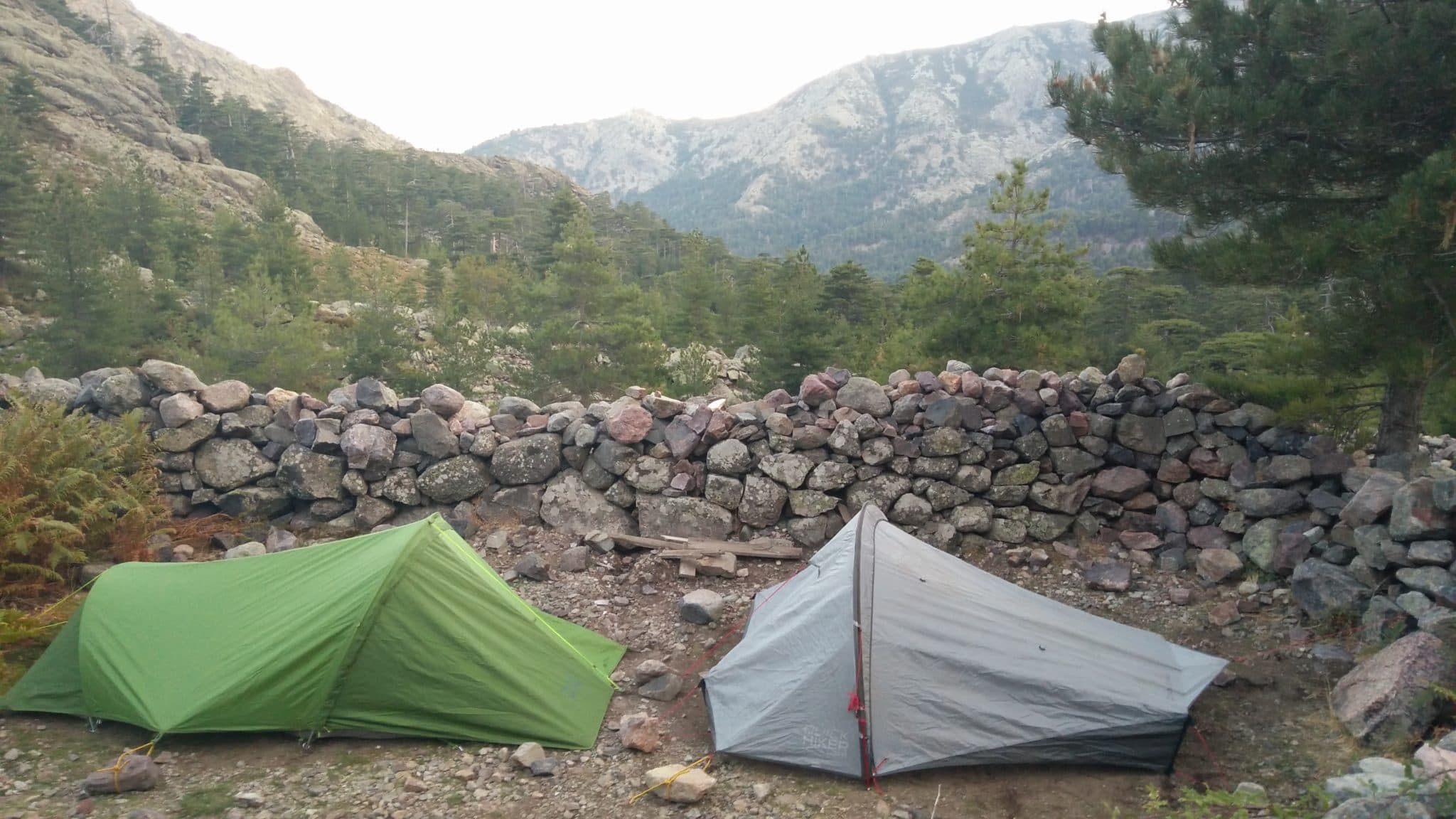
A small, muted-colour tent (olive, grey, tan) draws less attention. Keep it under 2 kg for mountain bivouacs.
- Sleeping bag rated to 0°C
Alpine nights above 2,000 m drop to 5°C even in July. A comfort rating of 0°C covers most summer situations.
- Sleeping pad
Insulated pad with R-value of 3 or higher for rocky alpine ground.
- Water filter or purification tablets
Essential below the treeline and in areas with livestock. A Sawyer Squeeze or BeFree filter weighs under 100 g.
- Gas stove and fuel canister
Open fires are banned in most areas. A compact stove like the BRS-3000T weighs just 25 g.
- Head torch with red light mode
Red light preserves night vision and is less visible from a distance.
- Trowel for waste burial
Bury human waste at least 20 cm deep and 60 m from water sources.
Dealing with Rangers and Locals
French park rangers (gardes-moniteurs) are generally professional and reasonable. If they find you bivouacking within the rules, there's rarely an issue. If you are in a restricted area, they'll typically ask you to move rather than issue a fine on the spot.
Farmers and landowners vary. In the Pyrenees and Massif Central, most are accustomed to hikers and will leave you alone if you're discreet. In popular tourist areas like Provence and the Côte d'Azur, expect less tolerance.
If you speak even basic French, use it. A simple "bonsoir, je suis randonneur, je pars demain matin" (good evening, I'm a hiker, I leave tomorrow morning) goes a long way.
Fines and Enforcement
Wild camping fines in France are set by local authorities, so they vary. For straightforward bivouac violations in national parks, expect fines of 135 EUR (a contravention de 4ème classe). More serious violations, like camping in a prohibited zone, lighting fires, or leaving waste, can carry fines up to 750 EUR or more.
In practice, enforcement is concentrated in a few areas. The Calanques, popular Mediterranean beaches, and the GR20 refuges see the most ranger activity. High alpine areas above the treeline are the least policed.
Fines in the aire d'adhésion (peripheral zone) of national parks are rare for discreet bivouackers. The core zones see more active patrolling, but even there, rangers typically give warnings before fines.
For a broader overview of wild camping rules across the continent, check our complete wild camping in Europe guide.
Plan Your French Bivouac
Wild camping in France rewards hikers who understand the system. Learn the bivouac rules, respect the national park boundaries, and pick your spots wisely. The Alps, Pyrenees, and Massif Central all offer world-class overnight experiences for those willing to do the homework.
For your first trip, the Ecrins or Pyrenees national parks are the easiest starting points. Clear bivouac rules, well-marked trails, and spectacular high-altitude terrain make them ideal. Pack light, arrive late, leave early, and you'll have some of the finest wild camping anywhere in Europe.
If you're planning a broader European trip, our wild camping in Europe guide covers the laws and rules for over 40 countries. If Scotland is on your list, the wild camping in Scotland guide covers the legal right to roam in detail. And for ultralight shelter options, see our guide to the best trekking pole tents.
Last updated on June 21, 2026.

Jasper Baetens
Hiking enthusiast from Belgium, mainly active in Europe. Created HikeHeaven to share experiences, research, tips, tricks and recommend products — or simply to help other hikers.