Can You Build Muscle Hiking? What the Science Says
Hiking works your glutes, quads, hamstrings, and calves hard. But can it build muscle? The honest answer, who benefits most, and how to push harder.


Hiking works your legs harder than most gym sessions. After a steep 20 km day with 1,000 metres of elevation gain, your quads burn, your glutes ache, and your calves remind you they exist. So it's reasonable to ask: can hiking actually build muscle, or does it just make existing muscle work harder?
The honest answer is nuanced. Hiking builds and maintains lower body muscle effectively, particularly for beginners and people returning from injury. Significant hypertrophy (actual new muscle growth) is limited for experienced exercisers because hiking lacks progressive overload. But that doesn't mean hiking is a weak stimulus. It depends heavily on who you are, the terrain you cover, and how you approach it.
Which Muscles Hiking Actually Works
Before getting into whether hiking builds muscle, it helps to understand what it's recruiting.
Glutes (gluteus maximus, medius, and minimus): These are the primary power source on uphills. Every step uphill involves significant glute activation to extend the hip and drive the body forward and upward. The steeper the incline, the greater the demand. On flat terrain, glute activation is lower.
Quadriceps: Your quads work hard on both uphills and descents, but for different reasons. On the way up, they extend the knee against gravity. On the way down, they work eccentrically (contracting while lengthening) to brake your descent. This eccentric load on downhills is particularly significant for muscle development.
Hamstrings: The hamstrings assist with hip extension on uphills and help control the leg during descent. They're involved throughout but typically less dominant than glutes and quads on trail hiking.
Calves (gastrocnemius and soleus): Every step pushes off through your calf muscles. On steep terrain and rocky trails, your calves work considerably harder than on flat pavement. Hikers with weak calves often notice cramping on long descents.
Hip flexors and abductors: Technical terrain with lateral movement, stepping over obstacles, and traversing slopes recruits the hip flexors, IT band, and abductors constantly. This is muscular work that flat gym cardio largely skips.
Core: On technical terrain, your core stabilises your spine and pelvis with every step, particularly when carrying a loaded pack. It's not the same as doing planks, but multi-hour core engagement under load builds real endurance in the stabilising muscles.
Upper body (with a loaded pack): Carrying a heavy pack recruits your trapezius, rhomboids, and shoulder stabilisers continuously. Using trekking poles adds tricep and lat engagement. It's endurance work, not hypertrophy work, but it's not trivial.
The Honest Answer: Build, Maintain, or Neither?
Whether hiking builds muscle depends on your current fitness level and what you mean by "build."
For beginners: Yes, hiking will build muscle, noticeably. If you're new to exercise or returning after a long break, your muscles will respond to the novel stimulus of hiking. You'll see visible development in your glutes, quads, and calves over 8 to 12 weeks of regular hiking, particularly if you're doing routes with significant elevation gain. The same adaptation process that makes any new exercise effective applies here.
For recreational exercisers: Hiking maintains and improves the endurance quality of lower body muscle, but significant size gains are unlikely without additional stimulus. Once your legs adapt to the hiking load, you've reached a plateau unless you progressively increase the challenge.
For trained athletes and regular gym-goers: Hiking adds muscular endurance and cardiovascular conditioning, but it won't produce meaningful hypertrophy. If you already squat and deadlift regularly, your legs have experienced far greater mechanical tension than hiking provides, and they won't respond by growing further without a greater stimulus.
The core limitation is lack of progressive overload. Muscle growth requires progressively increasing the mechanical tension on the muscle over time. In a gym, you add weight to the bar. On a trail, the terrain provides a relatively fixed level of resistance. Even carrying a 15 kg pack doesn't load the quads the same way that a 100 kg back squat does.
The Case for Hiking as a Muscle Stimulus
That said, dismissing hiking's muscle-building potential entirely is wrong. A few factors make it a more significant stimulus than it gets credit for.
Volume is enormous. A day hike involves thousands of individual muscle contractions over 6 to 8 hours. Even if the load per contraction is modest, the cumulative mechanical work adds up. Research on resistance training suggests that higher volumes with moderate loads produce similar hypertrophy to lower volumes with heavy loads, within limits.
Eccentric loading on descents is high. Descending steep trails puts your quads and calves under substantial eccentric load. This is the same type of loading that Nordic hamstring curls and plyometric work use in sports conditioning. Beginners and intermediate exercisers often experience genuine DOMS (delayed onset muscle soreness) after long descents, which is a marker of meaningful muscle stimulus.
The loads are bodyweight-plus. Hiking on steep terrain isn't just walking. Stepping up onto a rock or log with your full bodyweight plus a 10 kg pack, hundreds of times over a day, is meaningful mechanical loading. It's closer to step-ups and lunges than to flat walking.
Who Benefits Most
Beginners and those returning from injury: Hiking is an excellent resistance stimulus for anyone in the early stages of building lower body strength. It's low-impact compared to running, provides long duration loading, and doesn't require a gym. For this group, hiking is genuinely one of the best ways to build functional lower body muscle.
Older adults: After around age 50, maintaining muscle mass (sarcopenia prevention) becomes a primary health goal. Hiking is highly effective here. Research shows that regular walking on inclined terrain helps older adults maintain quad and glute mass, improve balance, and reduce fall risk. Building new muscle is harder with age, but preserving existing muscle through hiking is very achievable.
People who hate the gym: If the alternative to hiking is no exercise at all, hiking is an excellent muscle maintenance strategy. It won't replace targeted strength training, but it provides a meaningful baseline stimulus.
Experienced hikers adding difficulty: If you're already a regular hiker, adding significant elevation gain, pack weight, or moving to technical terrain provides new stimulus your body hasn't fully adapted to.
How to Increase the Muscle-Building Stimulus
If building lower body muscle is a specific goal, here's how to get more from your hiking.
Seek out significant uphill. Flat trails provide almost no muscle-building stimulus beyond what walking achieves. Routes with 800 metres or more of elevation gain per day keep your glutes and quads under meaningful load for extended periods. If you live somewhere flat, a stair-climbing machine is a useful substitute.
Use a weighted pack. Adding pack weight is the closest equivalent to progressive overload in hiking. Start at 5 to 7 kg and work up to 15 to 20 kg over several months. Rucking (structured weighted pack walking) is a training discipline built on exactly this principle. Even a moderate 8 kg daypack increases leg muscle activation by roughly 15 to 20% compared to hiking without a load.
Prioritise descents. Most hikers think of the climb as the workout and the descent as the recovery. Flip this. Descend technical steep terrain at a controlled pace and feel the quad burn. If you drive to the trailhead, consider doing laps on a steep descent section to accumulate more eccentric volume.
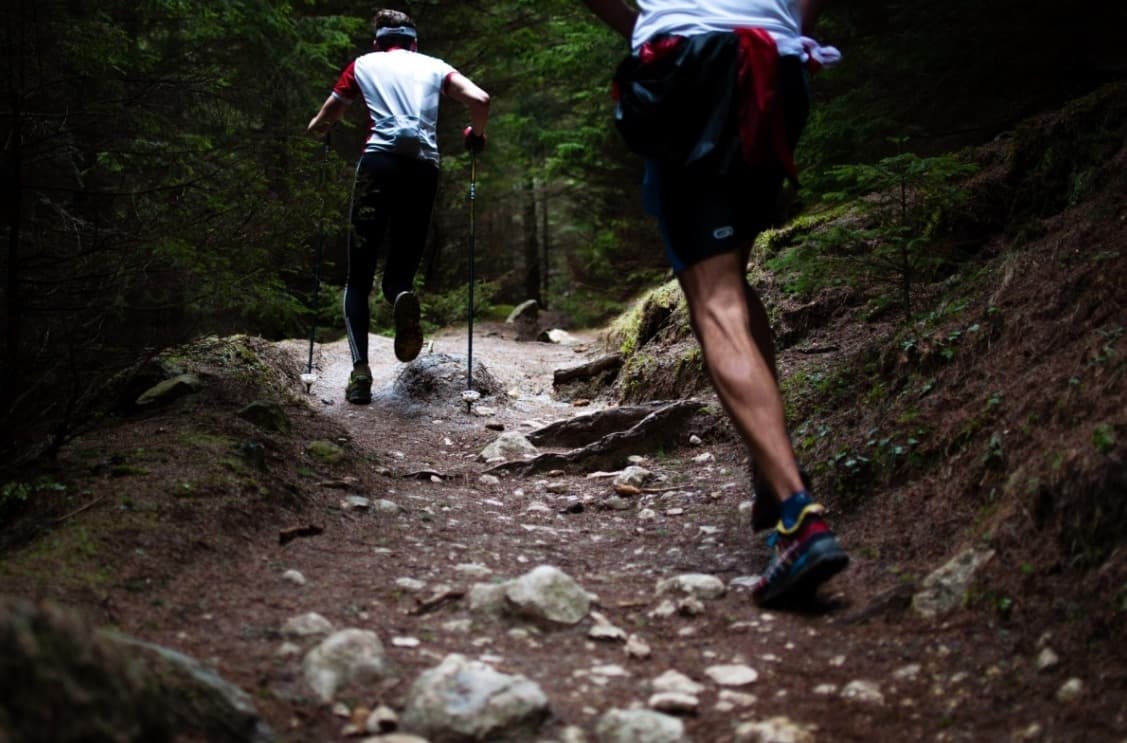
Use trekking poles strategically. This one is counterintuitive: trekking poles reduce leg muscle load by transferring some effort to your arms. If you want maximum leg stimulus, use poles only on very steep terrain and put them away on moderate ground. Our guide to one or two trekking poles covers how poles redistribute effort and when that trade-off is worth making.
Train the specific pattern. Step-ups, Bulgarian split squats, and single-leg squats at the gym improve hiking performance and create the progressive overload that trails can't provide. A couple of leg sessions per week alongside regular hiking is significantly more effective for muscle development than hiking alone.
Hiking vs. Gym Leg Training
To set realistic expectations, here's a direct comparison.
A typical gym leg session (squats, leg press, Romanian deadlifts) creates mechanical tension in the quads and glutes of roughly 100 to 200% of bodyweight per repetition. Hiking on steep terrain creates roughly 50 to 80% of bodyweight per step. The gym wins on peak load per repetition by a significant margin.
However, a 6-hour hike involves somewhere between 15,000 and 25,000 steps. Even a high-volume gym session involves far fewer total repetitions. The total mechanical work over a full hiking day is comparable to a significant gym session in terms of volume, just spread over a much longer time and at much lower intensity per rep.
The practical conclusion: hiking and gym training are better used together than as substitutes. Hiking builds the endurance base and metabolic capacity. Gym training provides the peak mechanical tension needed for hypertrophy. For more on how hiking fits into a broader fitness picture, our guide on how many calories hiking burns covers the energy demands and how they compare to other forms of exercise.
The Bottom Line
Hiking builds real muscle, particularly in your glutes, quads, calves, and core stabilisers. For beginners, the stimulus is substantial enough to produce visible results over weeks. For experienced exercisers, hiking is better understood as a muscle maintenance and endurance tool than a primary growth driver.
The practical approach is to hike regularly on challenging terrain, add pack weight progressively, and treat gym leg training as a complement rather than a replacement. Each makes the other more effective. Hiking builds the endurance capacity and movement quality; the gym provides the progressive overload needed to keep muscles growing.
If you're building a hiking fitness plan, understanding the calorie demands of your routes is also worth your time. Our guide to how many calories hiking burns covers the energy maths in detail and helps you plan fuelling around your training.
Last updated on June 21, 2026.

Jasper Baetens
Hiking enthusiast from Belgium, mainly active in Europe. Created HikeHeaven to share experiences, research, tips, tricks and recommend products — or simply to help other hikers.