Benefits of Hiking: Physical and Mental Health Gains
The real benefits of hiking: cardio fitness, muscle tone, calorie burn, mental health research, and how to hike more effectively for fitness gains.


The benefits of hiking are easy to measure. Hiking burns 430-700 calories an hour, strengthens your legs and core, improves cardiovascular health, and lowers cortisol levels measurably within 90 minutes of being on a trail. Those aren't vague wellness claims. They're documented outcomes with specific numbers behind them.
This guide covers the evidence for hiking's benefits across fitness, cardiovascular health, mental wellbeing, and joint health, plus how to structure your hikes if you actually want to get fitter rather than just walk.
Physical Fitness Benefits
Hiking builds fitness in two distinct ways: cardiovascular endurance and muscular strength. The combination is unusual for a single activity, which is part of why it's so effective.
The calorie burn is substantial. A 70 kg person hiking at moderate pace on undulating terrain burns approximately 430-530 calories per hour. Add significant elevation gain, a loaded pack, or rough terrain, and that number climbs to 600-700 calories per hour. Over a full 8-hour day with 1,000 m of ascent, a 75 kg hiker burns 3,500-4,500 calories total. For a detailed breakdown of exactly how terrain, pack weight, and pace affect the numbers, our calorie burn while hiking guide has the MET calculations.
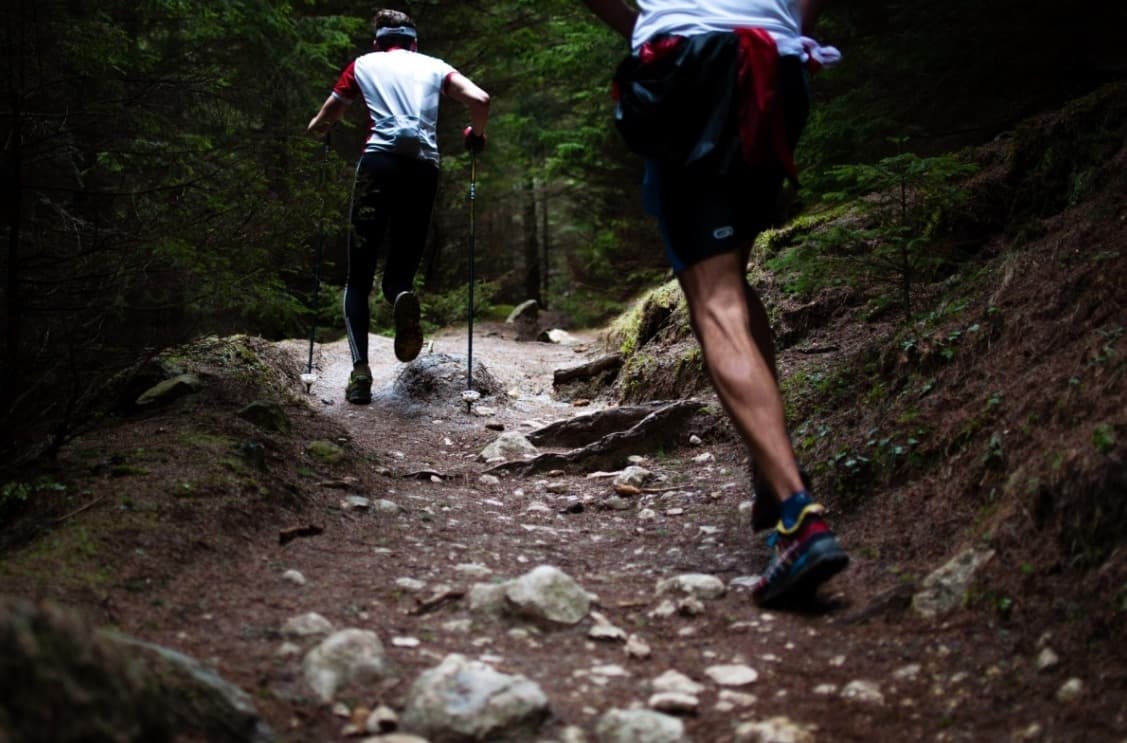
The muscular demands of hiking are more specific than people expect. Ascending trails heavily loads the quadriceps, glutes, and calves. Descending loads the quads eccentrically, which is the type of contraction that produces most post-exercise muscle soreness but also drives the most adaptation. Core muscles work continuously to stabilise the torso against an uneven surface and, if you carry a pack, against the additional load.
Regular hiking also improves hip flexor flexibility, strengthens the tibialis anterior (the muscle that prevents shin splints), and develops the smaller stabilising muscles of the foot and ankle that most gym exercise ignores entirely.
Cardiovascular Health
Hiking is a sustained moderate-intensity aerobic activity, and sustained moderate-intensity exercise has the strongest evidence base for cardiovascular benefit. Studies consistently show that regular hiking reduces resting heart rate, lowers blood pressure, improves HDL cholesterol (the protective kind), and reduces systemic inflammation.
A study published in the European Heart Journal tracking over 5,000 adults found that those who walked regularly on hilly terrain had a 31% lower risk of dying from cardiovascular disease compared to non-walkers. The gradient appears to matter: the cardiovascular demand of climbing even a modest hill is substantially higher than flat walking.
The mechanisms are well understood. Sustained aerobic exercise improves stroke volume (the amount of blood pumped per heartbeat), which allows your heart to pump more efficiently at rest. Over time, a trained heart has a lower resting heart rate because it moves more blood with each beat. Blood vessels develop better elasticity, reducing arterial stiffness and blood pressure. These adaptations don't require running. Consistent hiking produces them just as effectively.
For those managing blood pressure, a 2017 meta-analysis in the British Journal of Sports Medicine found that walking interventions reduced systolic blood pressure by an average of 4.1 mmHg. That's clinically significant, comparable to the effect of some antihypertensive medications, without the side effects. For more on how hiking stacks up against other aerobic exercise, see our breakdown of whether hiking is good cardio.
Can Hiking Build Muscle?
Hiking builds and maintains muscle, particularly in the lower body, but it has limits as a pure muscle-building tool. The quadriceps and glutes respond strongly to steep uphill terrain and loaded hiking. On long descents, the eccentric quad loading is intense enough to cause noticeable soreness in people who don't hike regularly.
That said, hiking without additional resistance (a heavy pack or steep gradient) doesn't provide enough progressive overload to build muscle in trained individuals. For the full answer on what hiking actually does to muscle mass under different conditions, our dedicated post on whether hiking builds muscle covers the physiology in detail.
The practical takeaway: if muscle maintenance and cardiovascular fitness are your goals, regular hiking delivers both. If significant hypertrophy is the target, you'll need to supplement hiking with resistance training or add a substantial weighted pack to the equation.
Mental Health Benefits
Hiking's mental health effects are among its most well-documented benefits, and the research goes beyond generic "exercise is good for mood" findings.
A 2015 Stanford University study published in the Proceedings of the National Academy of Sciences had participants walk for 90 minutes in either an urban or a natural environment and then measured activity in the subgenual prefrontal cortex (the region of the brain associated with rumination, the repetitive negative self-focused thinking linked to depression). Participants who walked in nature showed significantly lower activity in this region compared to urban walkers, even when both groups walked the same distance at the same intensity.
Cortisol, the primary stress hormone, decreases measurably after time in natural environments. A 2019 study in Frontiers in Psychology found that spending 20-30 minutes in a natural setting significantly lowered salivary cortisol concentrations. Hiking extends this exposure, compounding the effect over hours.
The mood benefits are partly neurochemical. Exercise increases serotonin and dopamine production. Being in natural light regulates circadian rhythms, improving sleep quality, which in turn improves mood and cognitive function. The physical demand of a hike also creates a form of focus: when you're navigating a rocky descent, your mind has no room for rumination.
Balance, Coordination, and Joint Health
Hiking on uneven ground demands constant micro-adjustments from your ankles, knees, and hips. Each step on an irregular surface engages proprioceptors, the sensory receptors in your muscles and joints that tell your brain where your body is in space. Regular engagement of these systems improves balance and coordination significantly over time.
This matters most for older hikers. Balance deteriorates with age and is a major factor in fall risk. A 2015 study in the Journal of Aging and Physical Activity found that regular hiking improved balance scores in adults over 65 more effectively than conventional gym exercise. The varied terrain is key: it's not just the exercise but the specific demands of walking on an unpredictable surface.
For joint health specifically, the evidence contradicts the common assumption that hiking damages knees. Moderate hiking is low-impact compared to running (the ground reaction force during hiking is 1.0-1.5 times body weight, versus 2.5-3.0 times during running), and the muscular strength developed around the knee joint actually protects cartilage by reducing direct bone-on-bone loading.
Hiking on trails also builds bone density, particularly in weight-bearing bones of the hip and spine. Weight-bearing exercise is one of the few proven non-pharmacological interventions for maintaining bone density as you age. Walking on flat ground provides some stimulus; hiking with a pack and elevation provides considerably more.
Social and Lifestyle Benefits
Hiking is unusual among fitness activities in how naturally it fits with social connection. Conversation happens easily at walking pace, without the interruption of gym machines or the difficulty of talking while running. Group hiking, walking clubs, and hiking with a partner all provide consistent social contact alongside the physical activity.
The lifestyle shift associated with regular hiking is also worth naming. Hikers tend to sleep better (partly from physical fatigue, partly from natural light exposure), spend more time outdoors in daylight, and develop a practical relationship with weather and seasons that reduces incidental stress. The habit of planning and preparing for a hike creates a low-stakes form of goal-setting that many people find extends into other areas of life.
Digital disconnection is a genuine benefit for many hikers. Trails often have limited mobile signal, which creates a natural break from the ambient demands of notifications and social media. Many people describe this as the part of hiking they notice most: not the view, not the exercise, but the absence of constant interruption.
For beginners nervous about getting started, our guide on common first hike mistakes takes most of the guesswork out of your first few trips.
How to Get the Most from Hiking for Fitness
Hiking as casual recreation is excellent for health. Hiking structured as a fitness tool requires some attention to variables that most casual walkers ignore.
Add gradient deliberately. Flat trails produce far less cardiovascular demand than hilly ones. If your local hike is largely flat, use a weighted pack or find routes with more elevation. Even 200-300 m of ascent transforms the cardiovascular demand of a 10 km walk.
Carry a pack. A 7-10 kg pack increases calorie burn by approximately 40-50 calories per hour for a 70 kg person and adds meaningful load to the muscles of the back, core, and hips. For people progressing toward fitness goals, a loaded daypack is the simplest way to increase the training stimulus without changing the route.
Increase frequency before distance. Two 10 km hikes per week is more beneficial for fitness than one 20 km hike. Frequency drives adaptation more effectively than occasional long efforts, particularly for cardiovascular health. If you can hike only on weekends, supplement with shorter weekday walks in hilly terrain.
Manage pace strategically. You don't need to hike fast to get fit. A sustained moderate effort (around 60-70% of maximum heart rate) for 3+ hours produces excellent cardiovascular stimulus. If you want to push harder, add short steep climbs at effort on the uphills rather than trying to move fast on the flat. For guidance on pacing and realistic distance expectations, our how many miles to hike in a day guide is a practical starting point.
If weight management is a goal, be honest about appetite. Many hikers compensate for a significant calorie burn with post-hike eating. This isn't necessarily a problem, but it's worth being aware of if the scale isn't moving as expected. Our fasting while hiking guide covers the specific case of hiking in a calorie deficit and what the research says about performance and safety.
FAQ
The benefits of hiking are broad, well-evidenced, and accessible to almost anyone with a reasonable level of base fitness. You don't need to hike fast or far to gain them. Consistent outings on varied terrain, even 2-3 hours at a time, deliver measurable cardiovascular improvement, meaningful calorie burn, and genuine mental health effects within a few weeks. If you're new to hiking, start with our advice on avoiding common first hike mistakes, then build from there.
Last updated on June 21, 2026.

Jasper Baetens
Hiking enthusiast from Belgium, mainly active in Europe. Created HikeHeaven to share experiences, research, tips, tricks and recommend products — or simply to help other hikers.